10, 12 & 14 Days In Morocco Itinerary From Marrakech (Epic!)
This post contains affiliate links, including Amazon affiliate links. If you purchase through these links, I may earn a commission at no extra cost to you. As an Amazon Associate, I earn from qualifying purchases. Thank you for your support!
Are you dreaming of the perfect Morocco itinerary but feel overwhelmed by all the options?
You’re in the right place!
I’m recently back from this beautiful country, where I spent my days wandering ancient medinas, climbing 500-foot Saharan sand dunes, and trekking through the High Atlas mountains — including summiting Mount Toubkal, the highest peak in North Africa!
When planning your Morocco trip, you’ll quickly realize there are endless possibilities. Luckily, with 10+ days in the country, you can pack a lot in.
To help you narrow it down, I’ve designed a completely modular 14-day itinerary that you can easily customize to fit your schedule and interests. I’ve also shared exactly how I would adjust this route for 10 or 12 days, as well as the perfect non-hiking swap if you’d prefer the ocean over the altitude.
On that note, keep reading to learn how to spend 10, 12, or 14 unforgettable days in Morocco!
✈️ Short on time? Here are some quick recommendations:
🚗 Tour Company/Driver: Toubkal Guide
🎉 Best Days Tours:
–3-Hour Walking Food Tour (Marrakech)
–Souk Tour and Traditional Home Cooking Class (Fes)
–Merzouga Dunes: Private Quad & Sandboarding Adventure (Sahara)
📲 eSIM: Airalo
☔️ Travel Insurance: SafetyWing (with the “Adventure Sports” add-on if you’re summiting Mount Toubkal)
✨ Free Planning Resources: Get my free Travel Planning Toolkit with budget calculator, Google Maps, planning cheat sheets, and more
Morocco Travel Logistics
Where is Morocco?
Morocco is located in the northwestern corner of Africa where the Atlantic Ocean, the Mediterranean Sea, and the Sahara Desert meet. It is the westernmost country in North Africa and is separated from Spain by only 8 miles (13 kilometers) across the Strait of Gibraltar.
Getting to Morocco
Most international travelers arrive to Morocco via the Casablanca Mohamed V International Airport (CMN) of the Marrakech Menara Airport (RAK), with Royal Air Maroc offering direct flights between Casablanca and major hubs like New York and Montreal.
If you are coming from Europe, you can find many affordable flights, or even take a high-speed ferry across the Strait of Gibraltar from Algeciras, Spain into Tangier, Morocco.
Getting around Morocco
🚊 Train. For traveling between major hubs like Casablanca, Fes, and Marrakech, the ONCF train network can be a more budget-friendly way to get around, though many reviews note that it is uncomfortable and unclean. For the itinerary I’ve laid out below, it’ll be much easier to rent a car or have a private driver.
Note: Their official website is currently not working, but you can view train schedules here.
🚌 Bus. For major hubs as well as destinations not reached by train like Essaouira and Chefchaouen, the CTM and Supratours bus lines can be a comfortable option with reclining seats and air conditioning.
🚗 Ride share. While there are no Ubers in Morocco, you can use the InDrive app to book rideshare services.
🚕 Taxis. In Morocco, there are Petit Taxis, which travel within city limits, and Grand Taxis, which can travel farther distances beyond city limits. With Grand Taxis, you can choose to pay for one seat and wait for the car to fill up, or buy out all six seats to have a private car.
🚘 Rent a car. Driving in Morocco is generally considered safe for confident and experienced drivers. Just remember you’ll first need to get an International Driving Permit from AAA. You can use Discover Cars to quickly compare your rental options and save up to 70%!
🚖 Private driver. This is how I got around Morocco, and how I recommend you get around for this itinerary, as the route isn’t easy to do via public transportation. I hired a fantastic driver named Ibrahim via Toubkal Guide.
📍Tour Company. Toubkal Guide also organized my entire trip. I used their services for 10 days of the itinerary. For 2 people, it cost $1,800 per person, which included hiking guides, trekking permits, drivers, accommodation (including private riads outside of the hike), most meals, and more.
Morocco Itinerary Overview & Map
Here is a quick overview of the stops on this Moroccan itinerary:
- Marrakech (2 nights)
- Ousertik Valley (1 night)
- Imnane Valley (1 night)
- Imlil (1 night)
- Mount Toubkal Refuge (1 night)
- Mount Toubkal Summit + Return To Imlil (1 night)
- Dadès Gorge (1 night)
- Merzouga, Sahara Desert (2 nights)
- Fes (2 nights)
- Casablanca (1 night)
To help give you a lay of the land, this Morocco travel map has everything pre-plotted:
🥾 Route Note: This specific route includes a 5-day trekking circuit through the High Atlas Mountains (Stops #2-6). It’s an epic hike that gives you a chance to see some of Morocco’s most stunning scenery, stay in remote Berber villages, and visit places most tourists miss.
If you aren’t a hiker, don’t worry—you can easily swap these days for more time in Marrakech or Fes, or a coastal trip to Essaouira, which I outlined below.
Detailed 14-Day Morocco Itinerary
Now let’s dive into our detailed day by day itinerary. If you love exploring through video, you can get a sneak peek at some of the highlights here:
After watching, keep reading for the full daily breakdown.
📍Stop #1) Marrakech (2 Nights)
About Marrakech
Known as the ‘Red City’ or ‘Ochre City’ due to the reddish color of its buildings and ancient ramparts, Marrakech (also spelled Marrakesh) is where history blends with modern civilization. You can visit museums and art galleries, stay at luxury hotels, and unwind in luxe spas, as well as walk the narrow alleys of the 11th-century walled medina, passing stalls of silk and spices and discovering hidden courtyard gardens.
Things to do in Marrakech
🚶♀️Tip: All of these attractions aside from the Jardin Majorelle complex are within the walkable Medina.
Walk the Medina. Dating back to 1070, this UNESCO World Heritage Site is the historic, walled part of the city. Strolling through the open-air and covered alleys, your senses will be hit by so many sounds, smells, and sights from vendors selling food, beauty products, clothing, souvenirs, and more. These winding roads eventually lead to Jemaa el-Fnaa, the next attraction on the list.
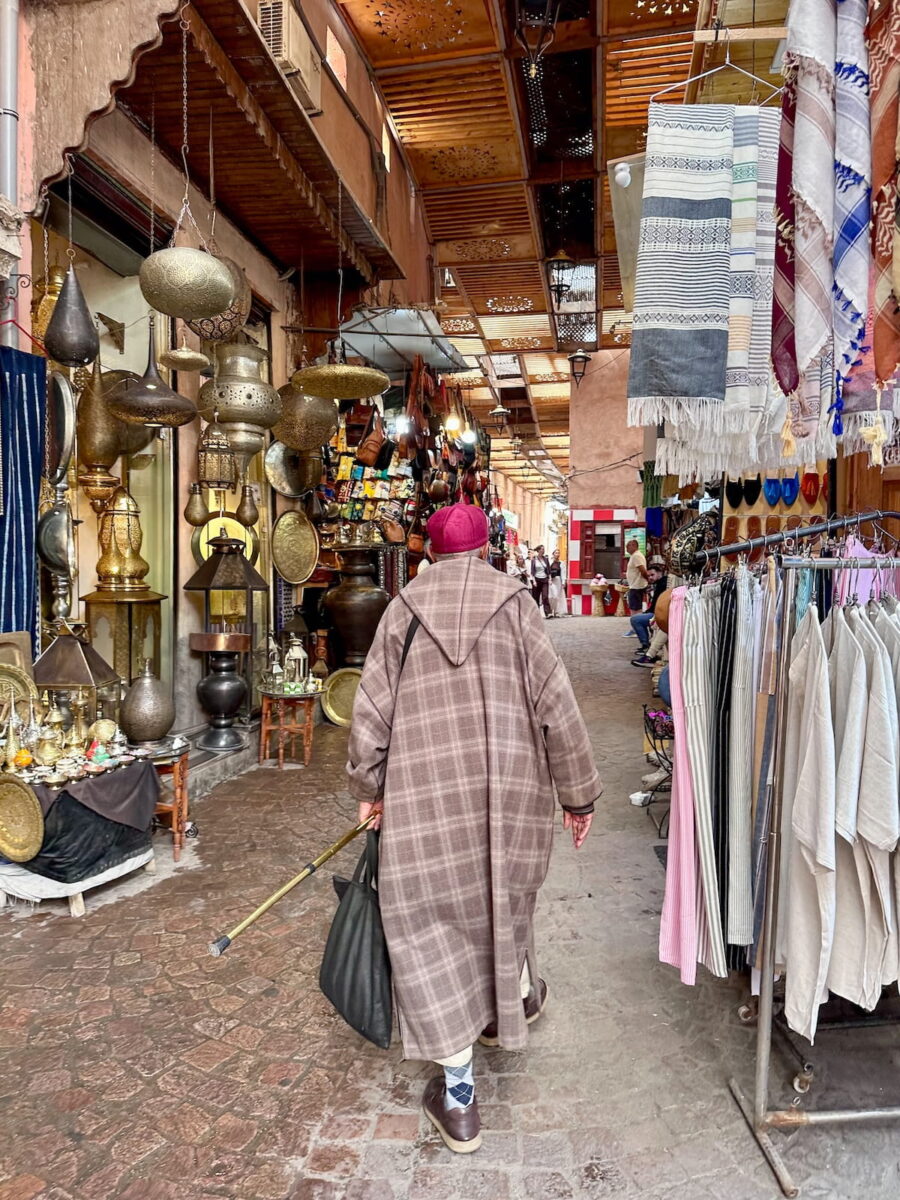
Visit Jemaa el-Fnaa. This main square is chaotic, loud — and so much fun! You’ll see sellers, food stalls, buskers, and more. While you should definitely walk through it, I also recommend grabbing a mint tea at one of the many rooftop terraces overlooking the square to take it all in.
🚨IMPORTANT: Do not take tourist photos with snakecharmers or monkeys. These animals are typically treated very poorly and you’ll be creating demand for experiences that promote animal cruelty.
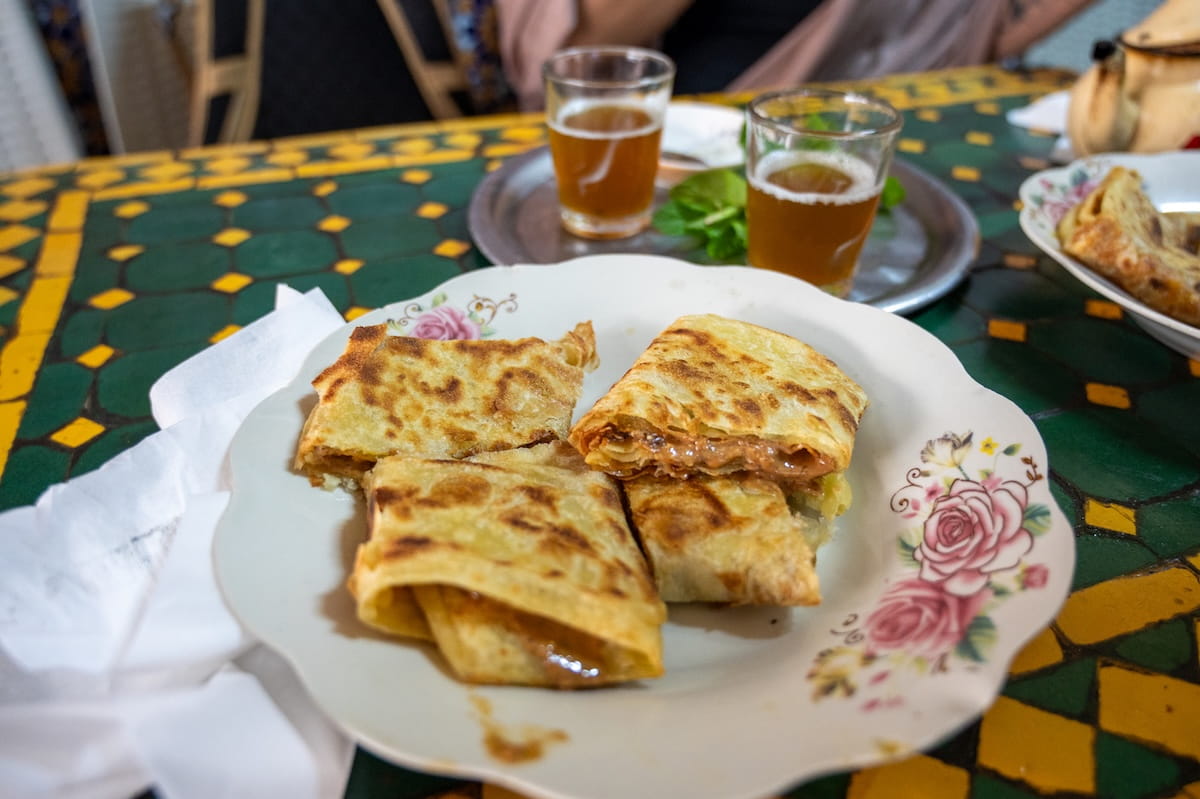
Fill up on a food tour. I booked this 3-Hour Walking Food Tour, and can honestly say I have never eaten so much on a tour! There were easily over 15 items sampled, from filling sandwiches, Moroccan stuffed pancakes (msemen), and harira soup to lighter bites like local yogurt, olives, and cookies — not to mention the excursion ended with dinner.
Along the way, my guide, Hanyn, shared history and culture to help us better understand the place we were exploring.
Fellow vegetarians, feel confident knowing Hanyn and his team will make sure you have plenty to eat!
Bahia Palace. If you’re short on time, put this attraction at the top of your itinerary. Built in the late 19th century, it was intended to be the greatest palace of its time and is known for its beautiful tilework and the painted ceilings.
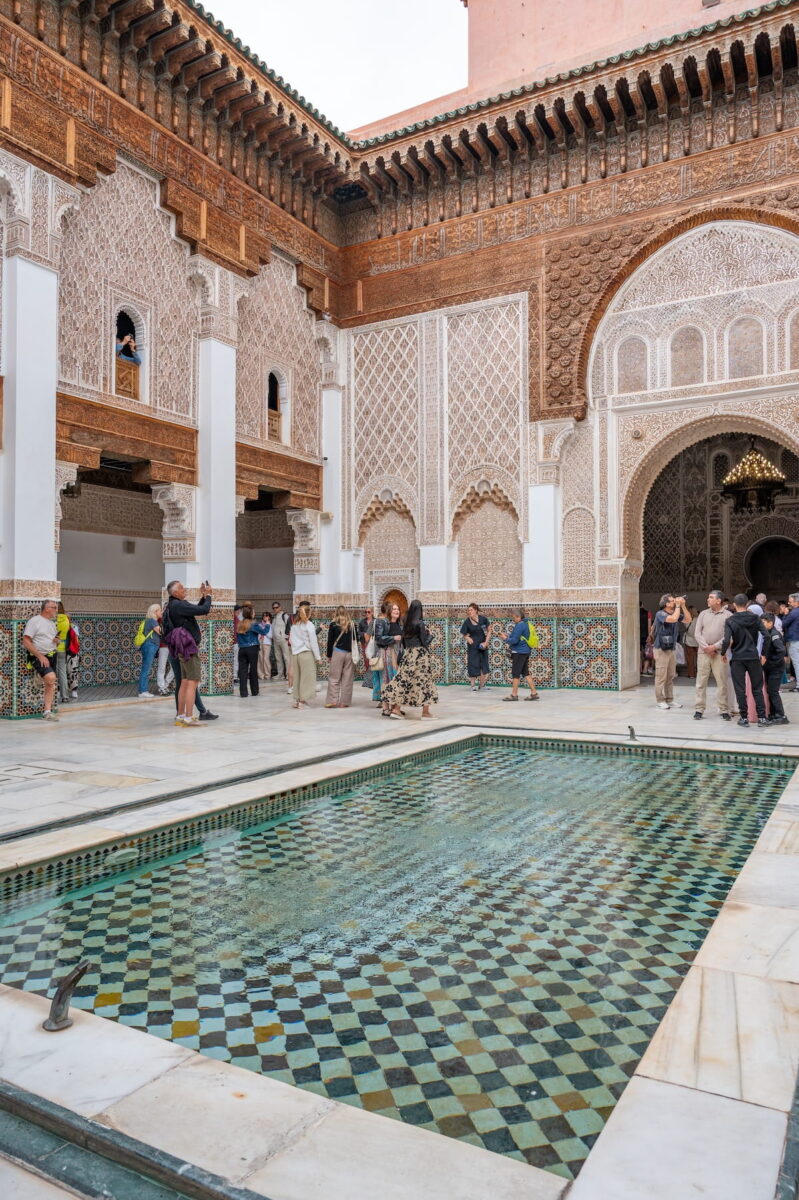
Ben Youssef Medersa. Dating back to the 14th century and later rebuilt in the 1560s, this was once the largest Islamic college in North Africa, housing up to 800 students. The architecture, central pool, and intricate carvings are incredible, and upstairs you can explore the former student dormitories and get an aerial view over the courtyard.
⭐️ Tip: See both attractions with a licensed guide on a Bahia Palace, Madrasa Ben Youssef, Souks & Medina Tour — which also includes bonus stops like the Koutoubia Mosque and the Mellah (Marrakech’s former Jewish quarter).
Explore local Marrakech museums. There are so many cultural and historical instituions to visit, like:
- Maison de la Photographie de Marrakech (House of Photography), which features historical photos of Morocco from 1870 to 1950. It’s very close to the Ben Youssef Medersa too! Price: 80 MAD.
- Musée de Mouassine (Museum of Mouassine Music) sharing traditional instruments, films on music culture, and live performances. Price: Included with your House of Photography ticket.
- Musée de l’Élégance Marocaine (Museum of Moroccan Elegance) showcasing 13 centuries of clothing traditions — including 200 miniature costumers, plus a lovely panoramic rooftop. Price: 50 MAD.
Jardin Majorelle, Yves Saint Laurent Museum, and Pierre Bergé Museum of Berber Arts. This complex is famous for its bright ‘Majorelle Blue’ Art Deco villa and a massive collection of desert plants from five continents. You’ll also be able to see how Marrakech’s colors influenced YSL’s fashion designs and view over 600 traditional artifacts in the Berber Museum. Important: You should book this in advance, as it sells out!
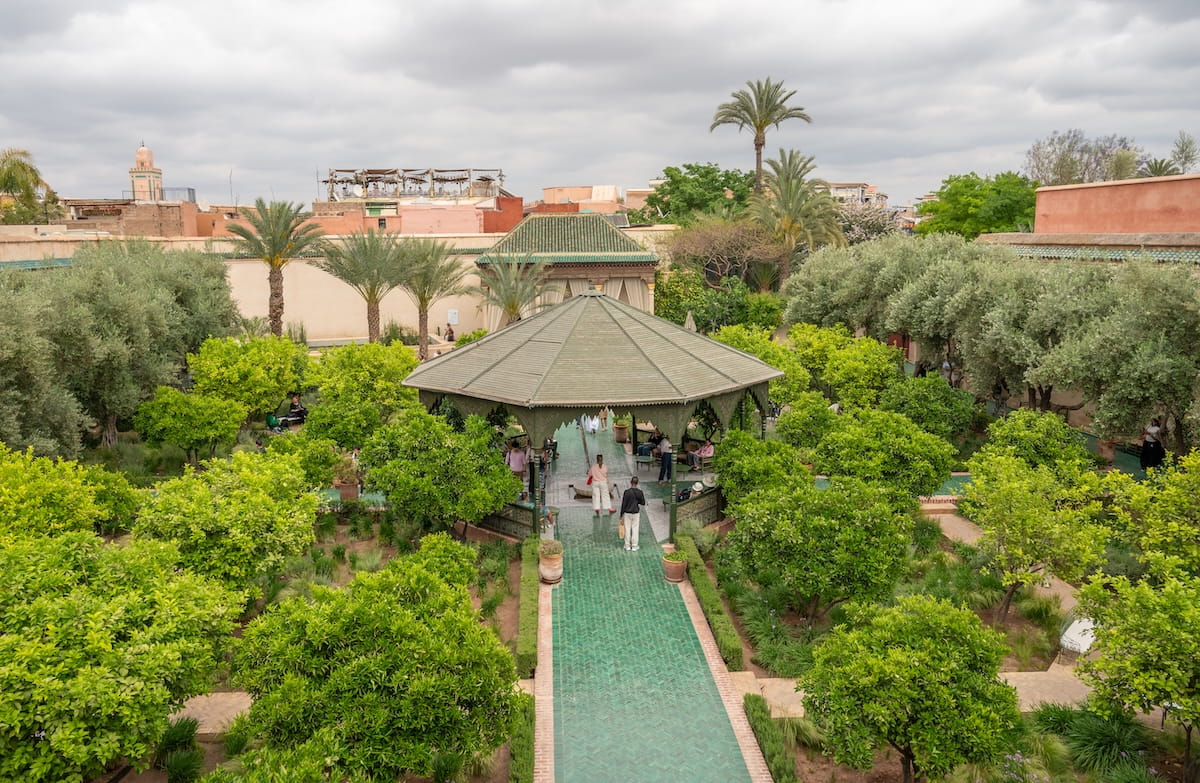
Le Jardin Secret (The Secret Garden). While smaller than Jardin Majorelle, this 16th century palace complex is beautiful and more convenient in terms of location (it’s right in the Medina) and availability (no need to book in advance). It features an Exotic Garden with plants from across the globe and a traditional Islamic Garden designed to represent paradise.
Where to eat
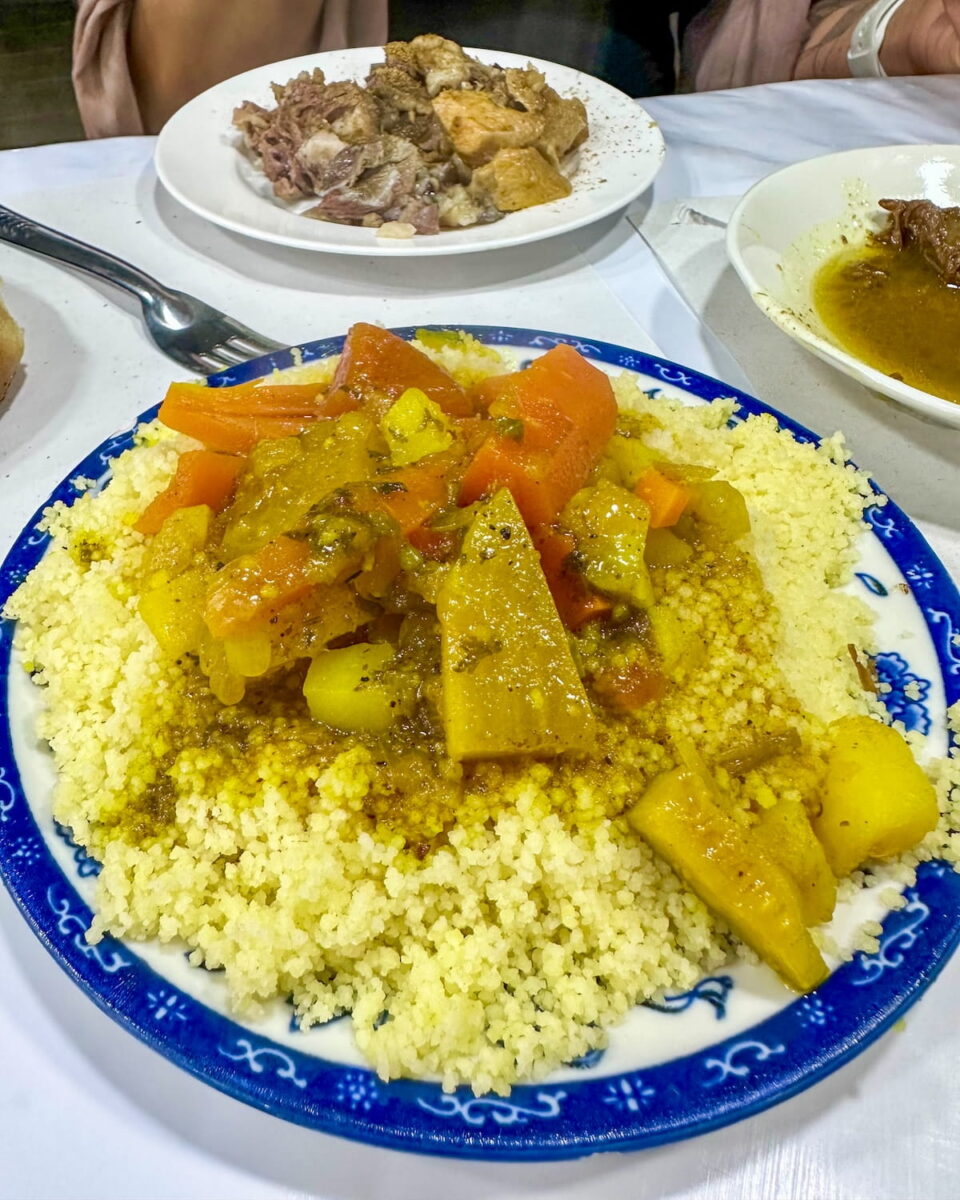
Jemaa el-Fnaa food stalls. There are many to choose from in Marrakech’s main square, all offering a budget-friendly meal. Personally, I had a delicious vegetable couscous at Chez Hassan (Stall #47)!
Dabachi Chez Cherif. This was recommended by my riad, and it was a great spot to enjoy a delicious tagine and some harira soup while people-watching in the Medina. While eating, I was even entertained by fire dancers.
L’mida. For something upscale and delicious, this rooftop serves modern Morrocan fusion dishes made with local ingredients like Tanjia Ravioli, Gnocchi Berber, or the Miso and Harissa Coleslaw paired with Atlas Mountains views.
Where to stay in Marrakech
Especially if it’s your first time visiting Marrakech, you should stay in Medina. Not only does this put you near Marrakech’s main attractions, but you’ll be sleeping in over 950 years of history.
During my time in Marrakech, I stayed in two different riads (traditional Moroccan accommodations):
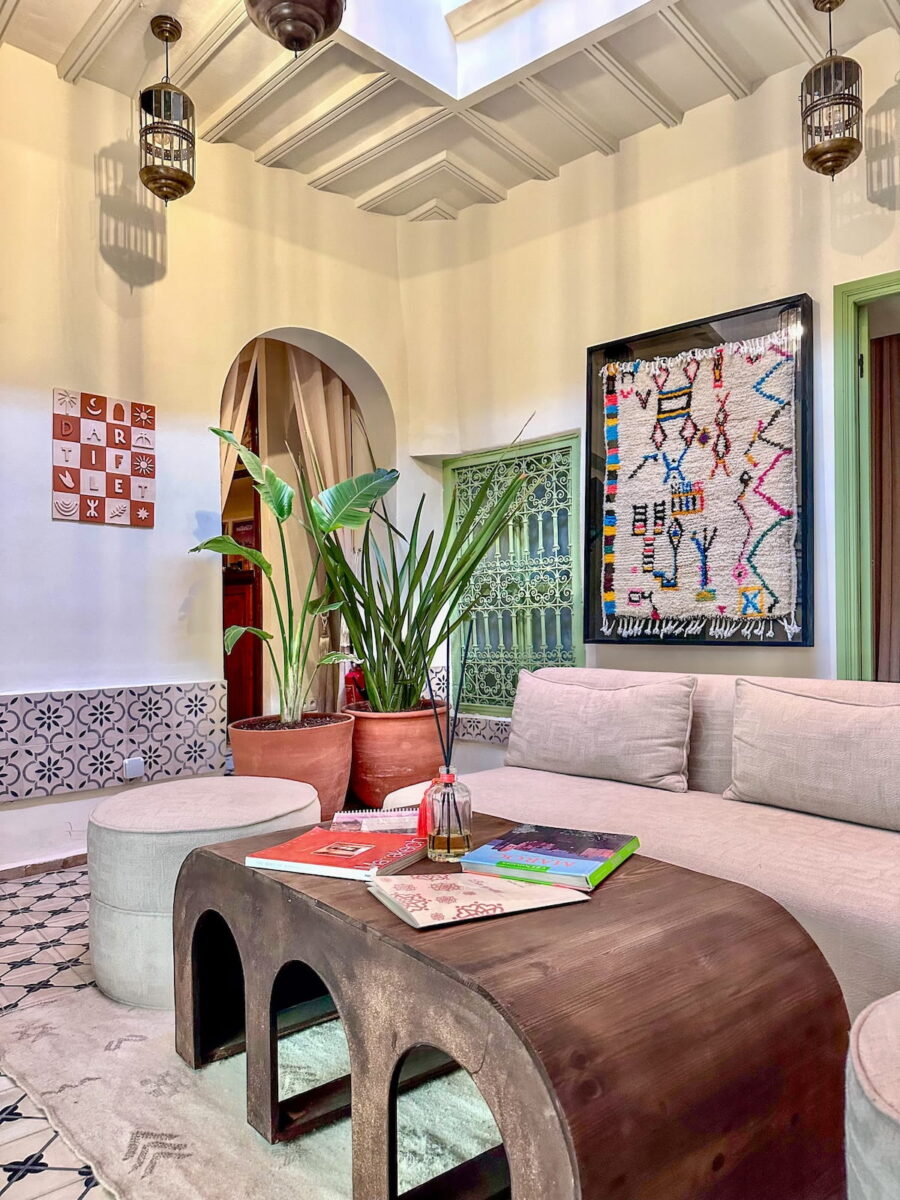
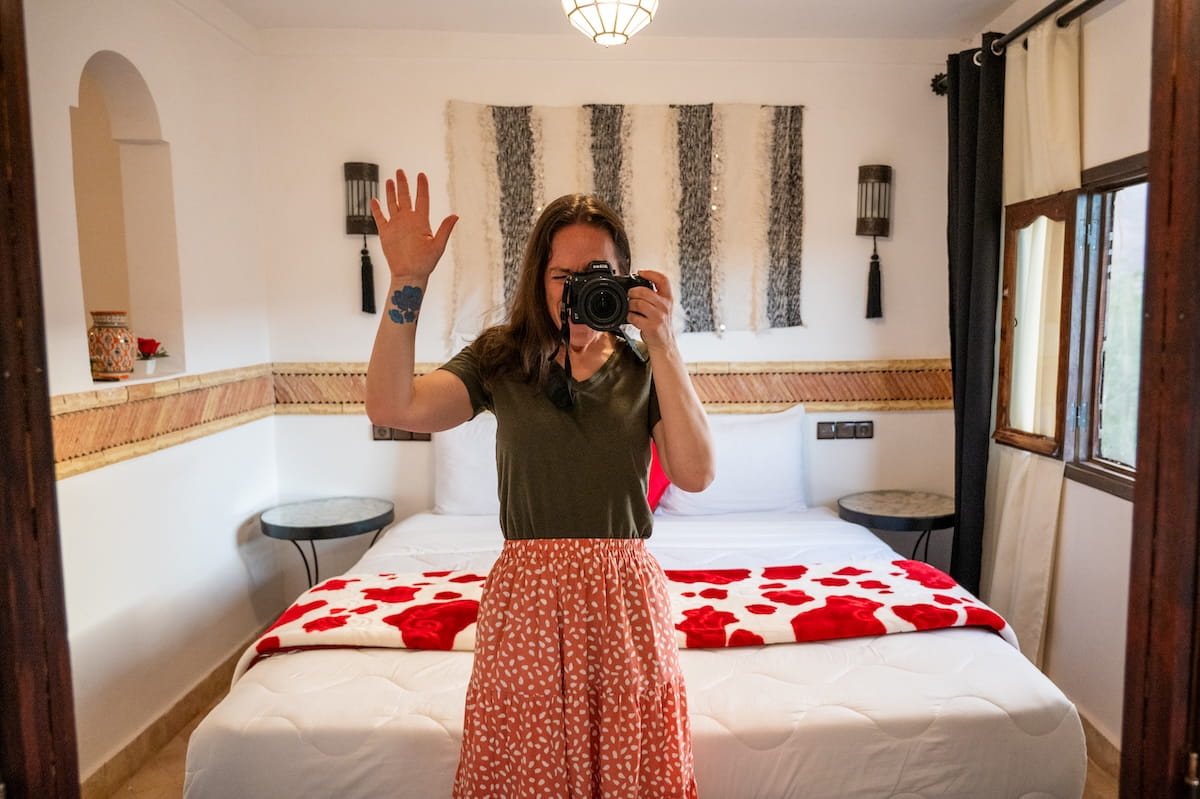
🏨 Riad Dar Tiflet is a great accommodation option about a 10-minute walk to the main square of Jemaa el-Fnaa. Once the home of a Berber spice merchant, the rooms immerse you in Moroccan culture through vaulted ceilings, colorful zellij tiles, and hand-painted walls — though my favorite part of the riad is the chill rooftop with tables and day beds. The guest manager, Yassine, also goes above and beyond to make sure your stay is excellent!
🏨 Riad Hilmuna is closer to the airport and Jardin Majorelle. It feels a bit more upscale, with a warm indoor pool in the lobby, an onsite spa, and a rooftop with restaurant.
Both properties include breakfast, WiFi, and can arrange airport transfers.
Stop #2) Ousertik Valley (1 night)
Recommended trekking guide
This stop begins the hiking portion of this Morocco itinerary! While I used Toubkal Guide for my entire trip, you can also DIY a lot of it if you prefer.
That said, it is mandatory to have a guide to summit Mount Toubkal. I recommend just using their services for the entire trek, as they’ll arrange everything — an experienced guide, food, accommodation, transport, and more.
Getting to the High Atlas Mountains
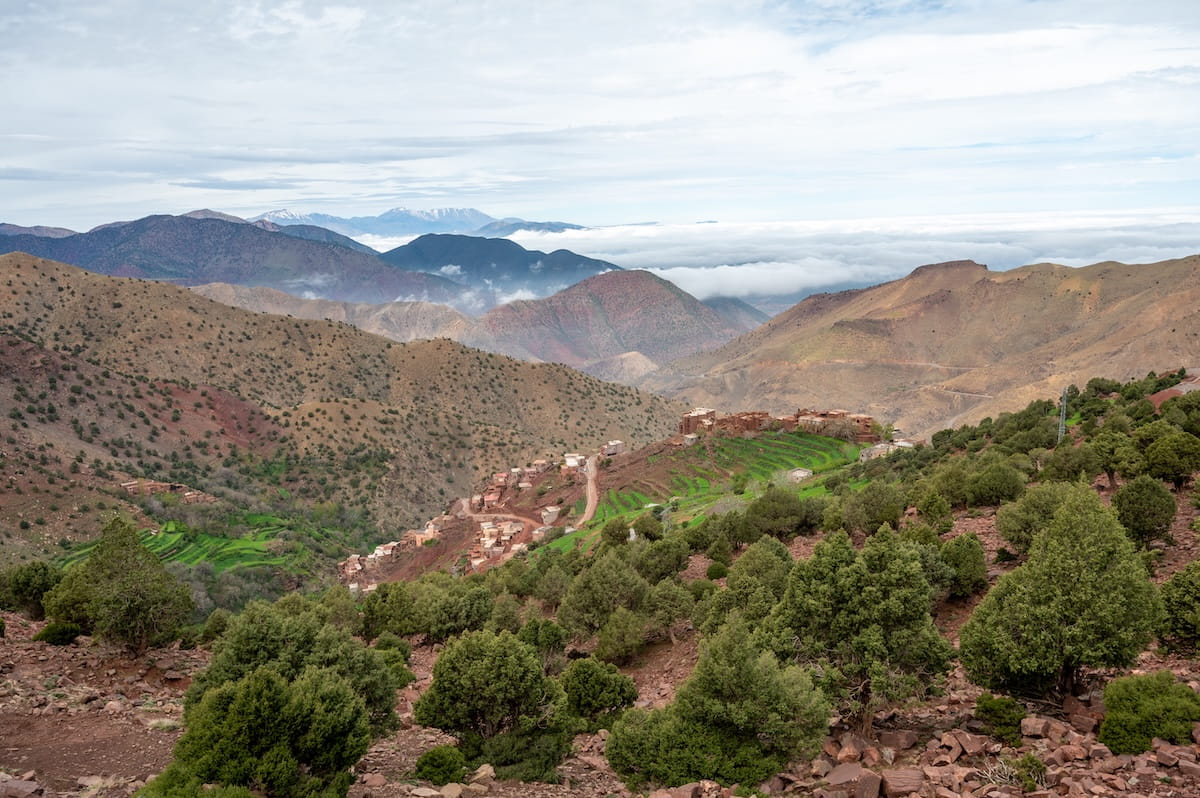
The 90-minute drive from Marrakech to Aguersioual, the starting point of our 5-day Atlas Mountains trek, features open roads lined with olive trees, Berber villages, and even Mission Impossible filming locations.
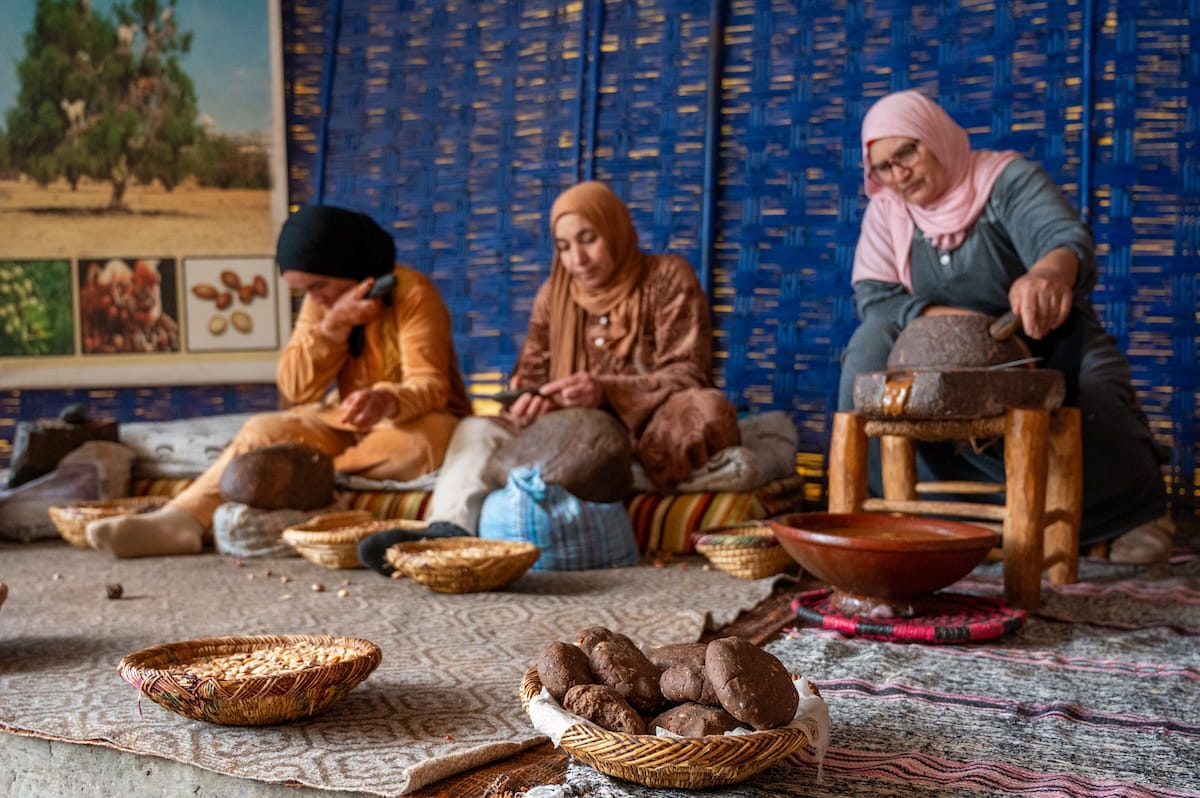
On the way, stop at Cooperative Feminine Aldayne to see how local women produce argan oil, sample their tasty honey and almond spreads, and have a light breakfast with mint tea.
Afterward, head to Aguersioual to meet your guide, mule, and muleteer—who will drive and pack the mule to transport your luggage.
During my trip, I had Omar as my guide and Mohammed as the muleteer and cook. He made some of my favorite meals from the entire trip, like fresh salads, macaroni, vegetable couscous, and more!
Hiking in the Ousertik Valley
- Difficulty: Moderate.
- Elevation Gain: 530 meters.
- Time: About 5-6 hours of hiking.
This trek is a steady ascent from 1,600 to 2,130 meters through a landscape so lush it feels like a fairytale, complete with wild purple irises and thousands of butterflies and ladybugs—which continue throughout the entire five days.
About an hour in, you’ll reach the Tizi n’ Aguersioual (Aguersioual Pass) for a prime view of the 3,882-meter Bou Iguenouane peak before descending into the Imnane Valley.
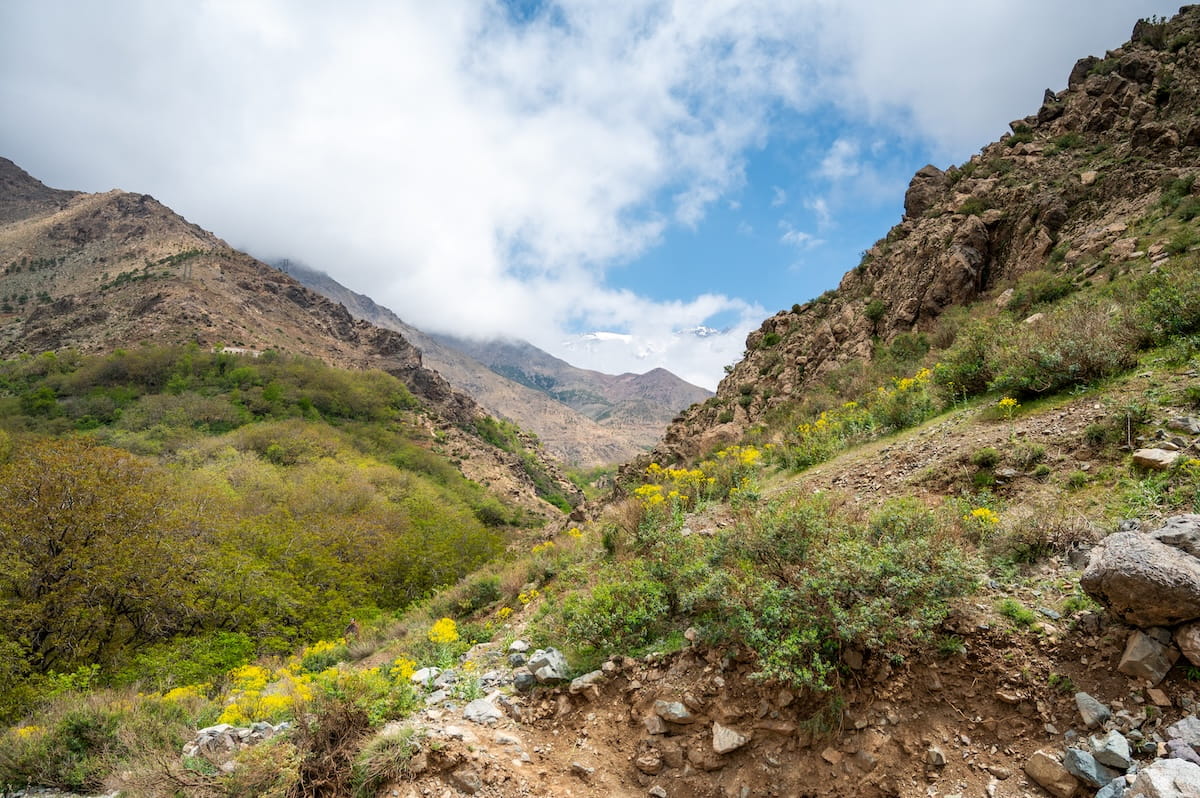
Within 30 minutes you’ll hit a lovely crystal river, which is a great spot for a picnic.
The day ends with a climb through the Ousertik Valley passing twisted forests and waterfalls—which, if the mountain mist rolls in, creates a smoky atmosphere that is fun to hike through.
Ousertik Valley accommodation
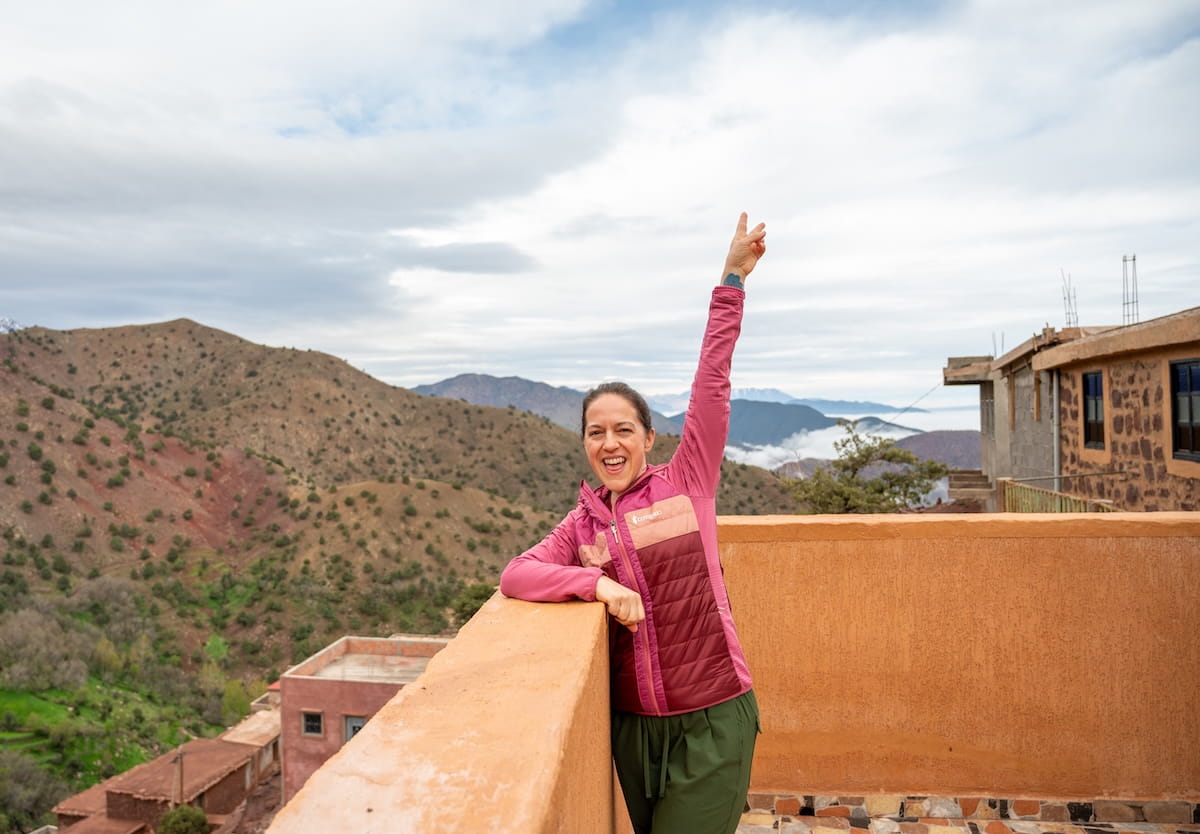
🏨 Gite Atlas Imzoughe (2,130 meters). This simple and clean guesthouse in Tissili Village offers a peaceful mountain escape in a small Berber village. You’ll have hot showers, plenty of outlets, private rooms with comfortable beds and plush blankets, and a large balcony featuring beautiful views over terraced hillside and out toward the Atlas Mountains.
Stop #3) Imnane Valley (1 night)
Hiking in the Imnane Valley
- Difficulty: Moderate-Challenging.
- Elevation Gain: 870 meters.
- Time: About 5 hours of hiking.
The hike from Tissili Village (2,130 meters) begins on a gradual uphill trail along a red dirt road where you’re literally in line with the clouds. They create a thick blanket over the Ousertik Valley’s terraced fields.
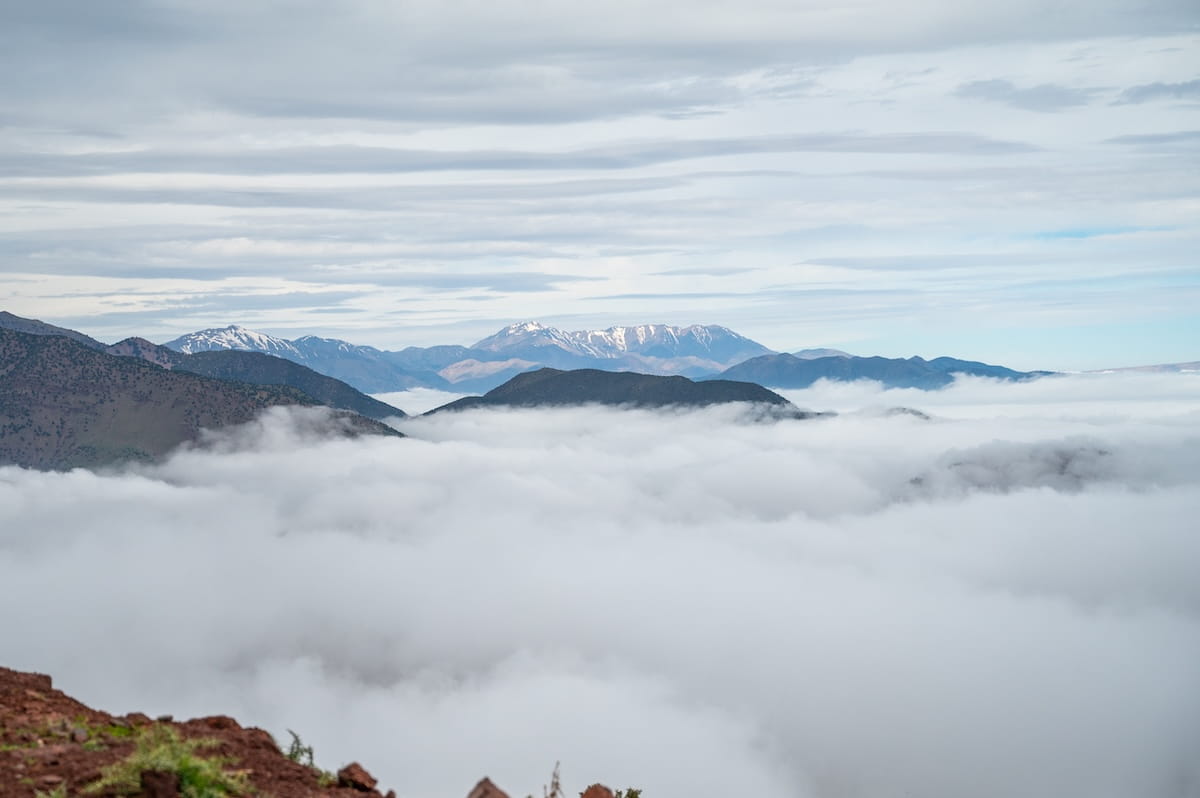
As you climb, the scenery becomes beautifully layered, with red mountains dotted with trees and backed by grey jagged rock and snowy peaks.
Along the way, there is an official photo spot (you’ll see a weathered metal orientation map) with a front-row view of the entire Atlas range, including notable peaks like Mount Toubkal, Ouanoukrim, and Erdouz.
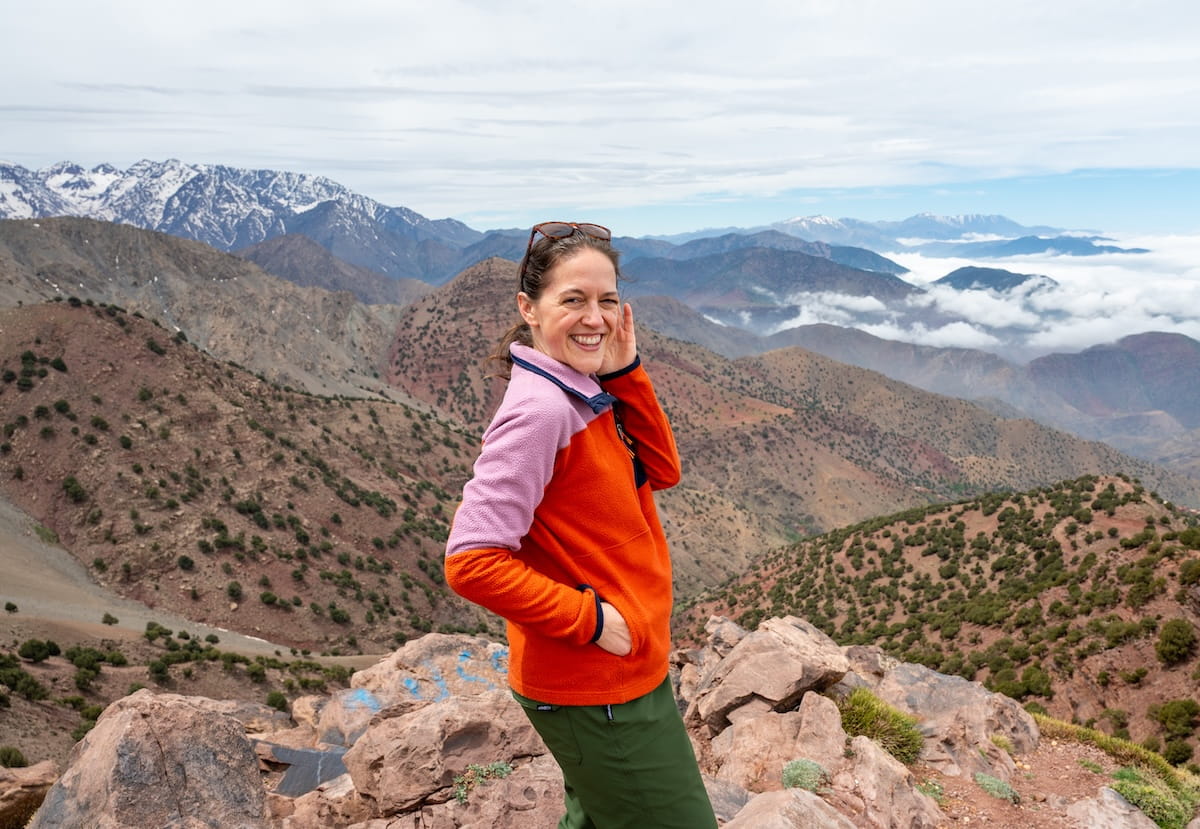
You’ll also hike through Oukaimeden (2,600 meters)—the highest ski resort in Africa. It’s a great location to stop for a picnic lunch with mountain views.
Soon after, you’ll enter Toubkal National Park, passing small waterfalls and the summer stone homes of nomadic Berbers.
The final stretch is a zig-zag climb to the Tizi ‘n Addi (Addi Pass) at 3,000 meters, which envelopes you in the clouds and offers a panoramic view that made me pull out my camera every minute.
🥾 Tip: The hike down from this mountain pass through the Imnane Valley is a steep and challenging 2-hour descent over loose rock and gravel. Ankle support is a must, and I highly recommend buying your hiking boots at least a half-size up so your toes don’t hit the front of your boots on the long downhill.
Imnane Valley accommodation
🏨 Riad imNane Lodge (2,100 meters). Located in the small Berber village of Tamguist, this guesthouse is comfortable and clean with mountain views from the rooms and terrace. It offers hot showers, plenty of power outlets, and comfortable beds with plenty of blankets.
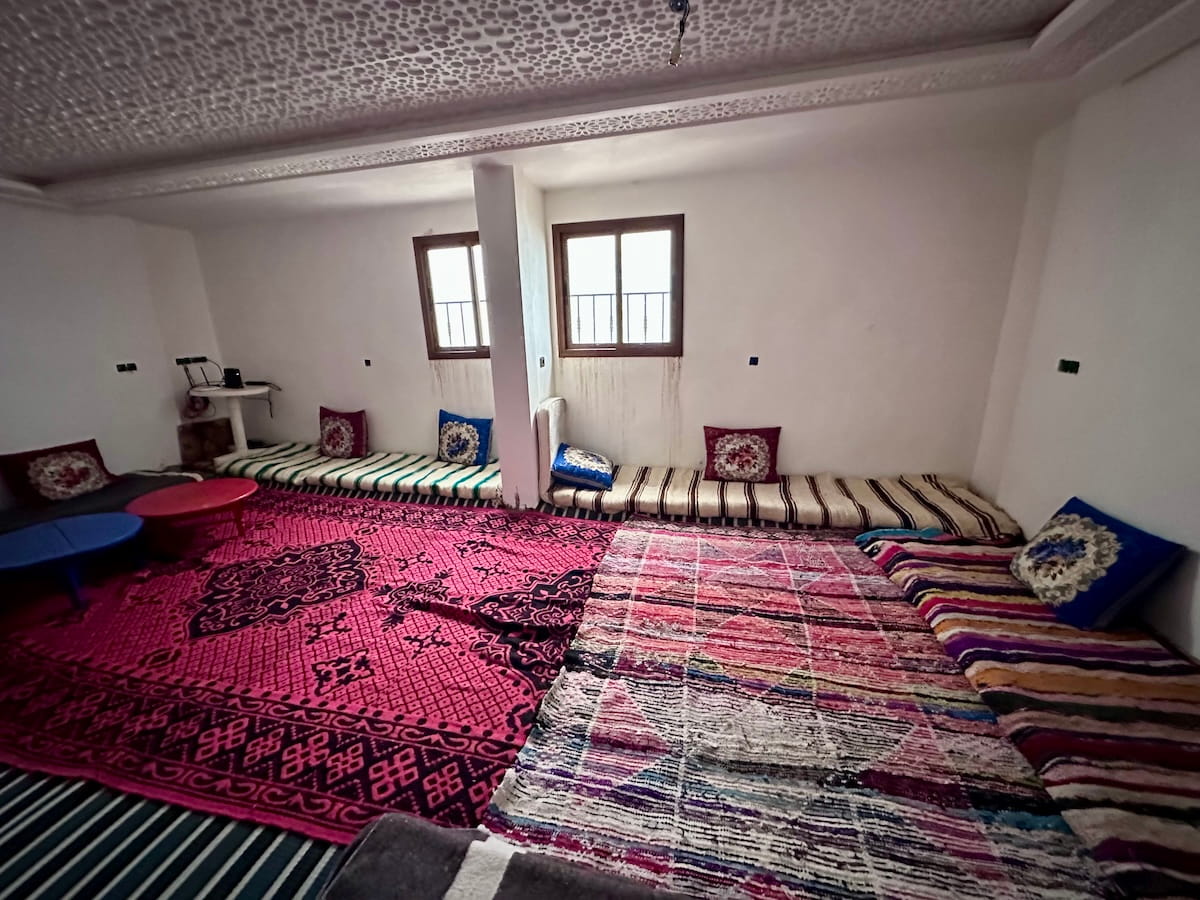
Stop #4) Imlil (1 night)
Hiking to Imlil
- Difficulty: Moderate.
- Elevation Gain: 202 meters.
- Time: About 3-4 hours of hiking.
While we were almost completely alone for first two days of the trek, this stretch is where you’ll start to see other hikers enjoying the Imnane Valley.
The trail moves from a leisurely downhill with mountain views into a shady pine forest filled with white butterflies, grazing sheep, and muleteers.
You’ll criss-cross up a steeper dirt road with loose rock to reach the Tizi ‘n Tamatert (Tamatert Pass) at 2,302 meters, where there is a small rest stop for snacks and a bathroom break.
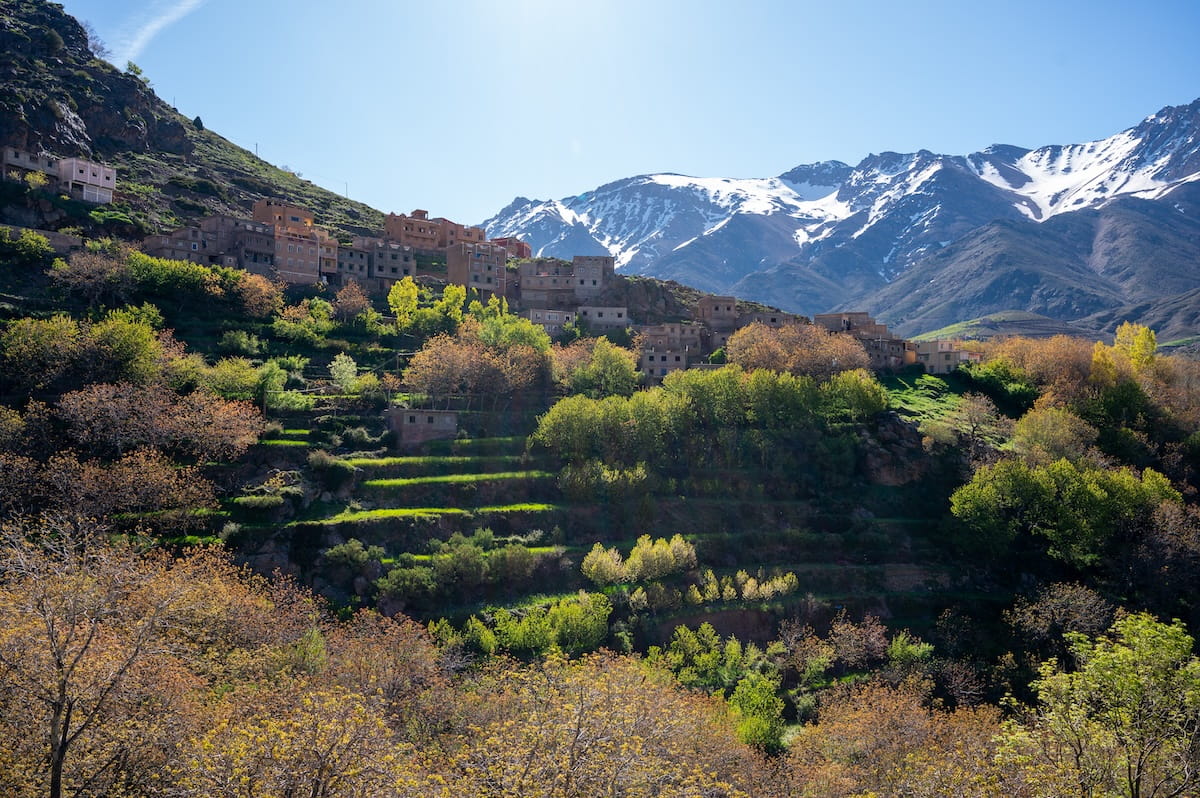
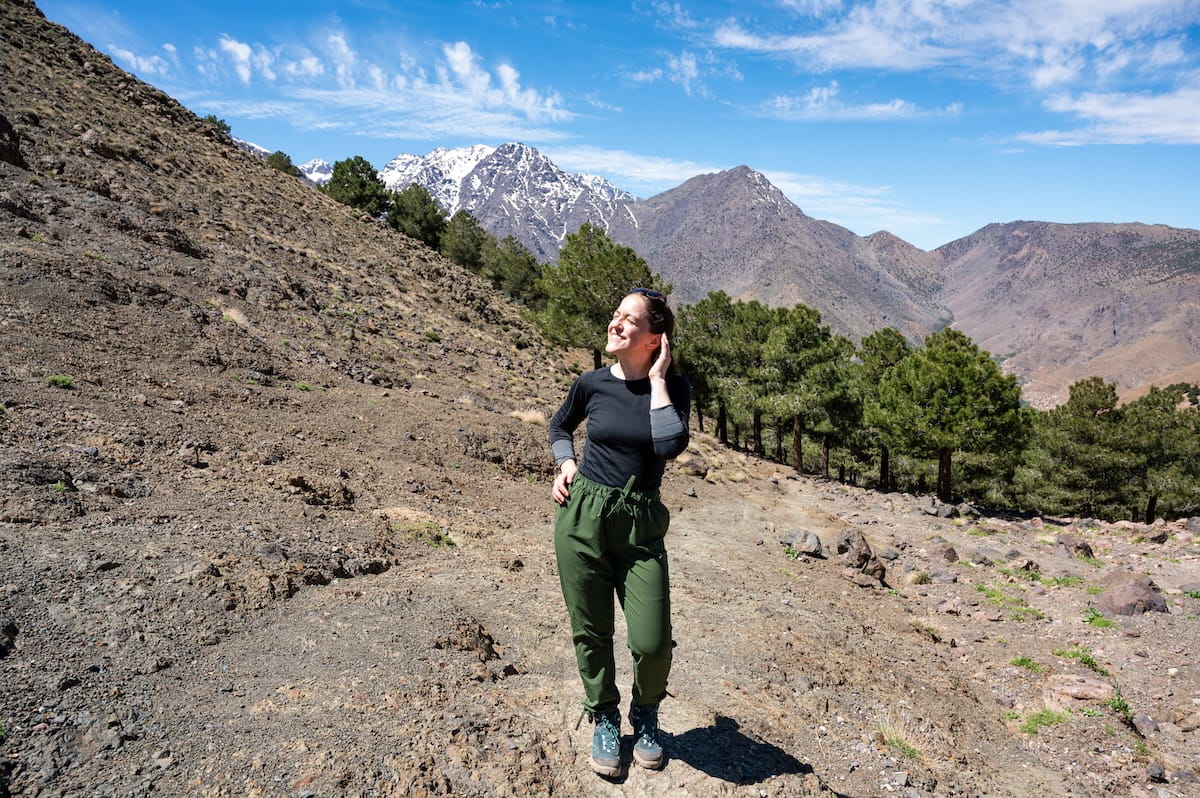
As you descend toward Imlil (1,800 meters), you’ll get a prime view of Mount Toubkal. It’s a wild feeling to realize you’ll be standing on that peak in just two days!
Stop in the forest for a picnic lunch, before continuing on to your guesthouse in Imlil.
Things to do in Imlil
Unlike the previous remote Berber villages mentioned, where the appeal is really enjoying the peace, quiet, and views, Imlil is a lively adventure town. It’s the primary pre-trek overnight stop for hikers preparing to summit Mount Toubkal and features loads of restaurants, gear shops, and ATMs.
While you’ll likely spend today just resting after a full day of hiking, it’s worth taking a stroll through the center of Imlil to peruse the shops and sip mint tea on a rooftop terrace while enjoying Atlas Mountain views.
Imlil accommodation
🏨 Atlas Imoula Guest House (1,800 meters). This guesthouse is located just a 15-minute walk to Imlil’s main center — far enough way to be peaceful yet close enough to be accessible. The rooms are very comfortable with thick blankets, hot showers, air conditioning, and WiFi. There is also a tasty onsite restaurant (my tagine was delicious) and terrace offering mountain views.
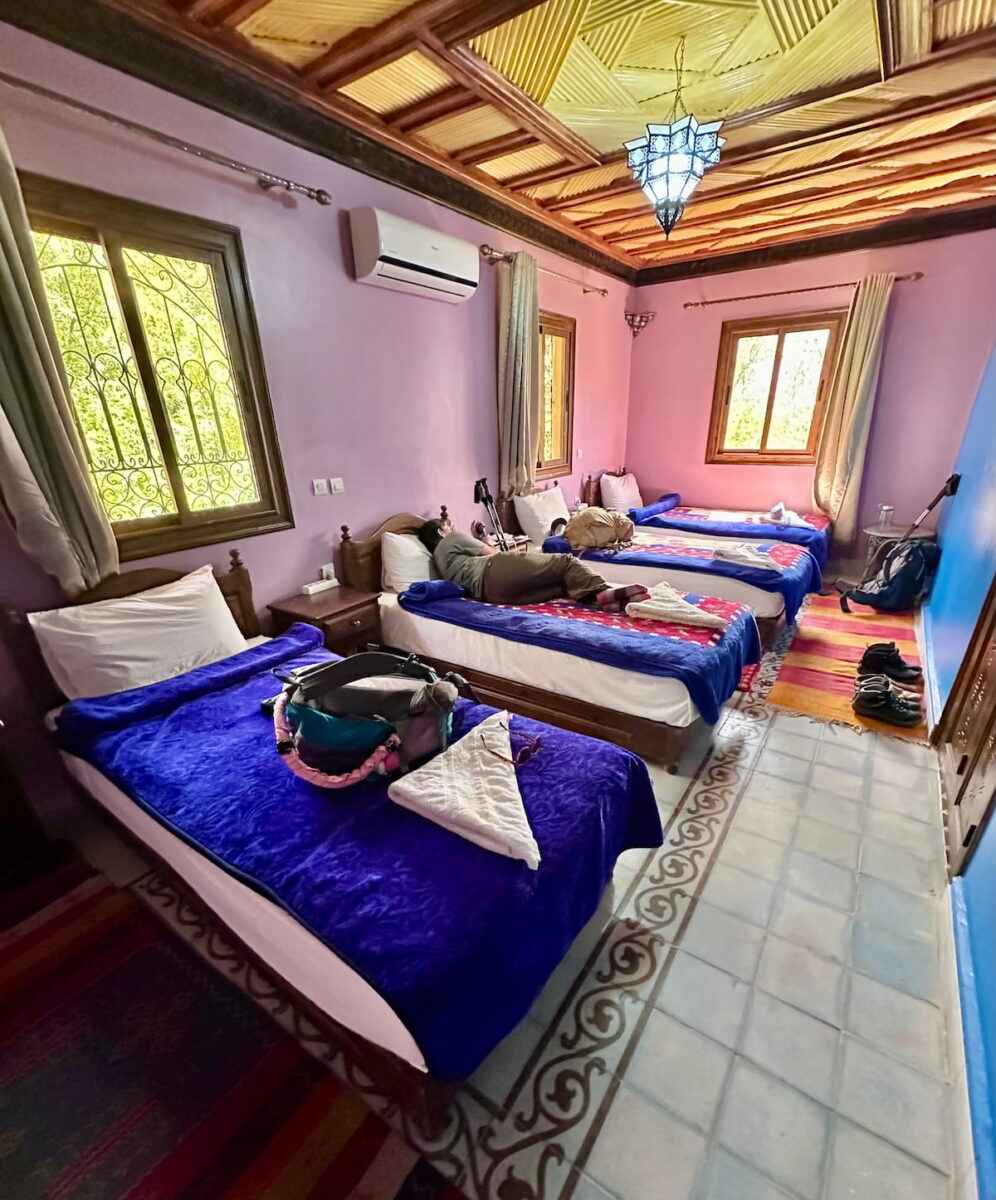
Stop #5) Mount Toubkal Refuge (1 night)
Beginning the trek up Mount Toubkal
Today you’ll trek to the Mount Toubkal Refuge, the base camp for the hike, where you’ll stay the night before a 4am summit ascent.
🗺️ Route Customization Tip: If you’re short on time or want more days in Marrakech, it is possible to skip the Ousertik and Imnane Valleys and simply drive to Imlil to begin your trek from here. However, if you can, it’s worth keeping the trek 5 days (instead of 2 days) to really immerse yourself in High Atlas beauty and rural Moroccan life.
🥾 Packing: Click here for a detailed Toubkal trek packing list.
Hiking to Mount Toubkal Refuge
- Difficulty: Moderate/Challenging.
- Elevation Gain: 1,406 meters.
- Time: About 5-6 hours of hiking.
The day starts with a short hike to Imlil Cascade (Waterfall) to see its powerful gushing flows.
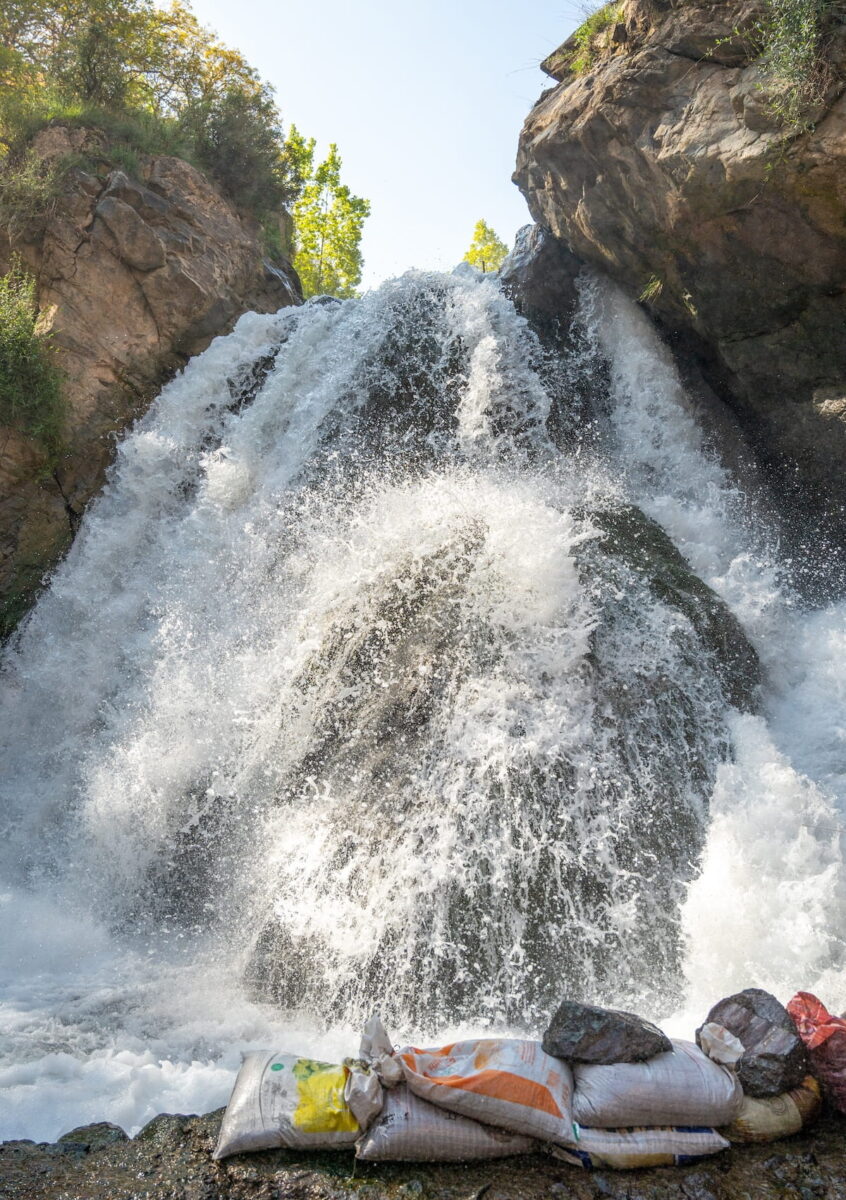
From here, pass through Aroumd (Armed), the highest village in the Imlil Valley at 2,000 meters and the final settlement before entering Toubkal National Park.
(Yes, you entered it already before, but then you left and are now entering it again.)
As you leave the village, the landscape turns into lush fields of green grass and flowers, offering a prime view of the snow-capped Toubkal summit. Make sure to get some photos before you begin the ascent and then at the summit to show how far you’ve come.
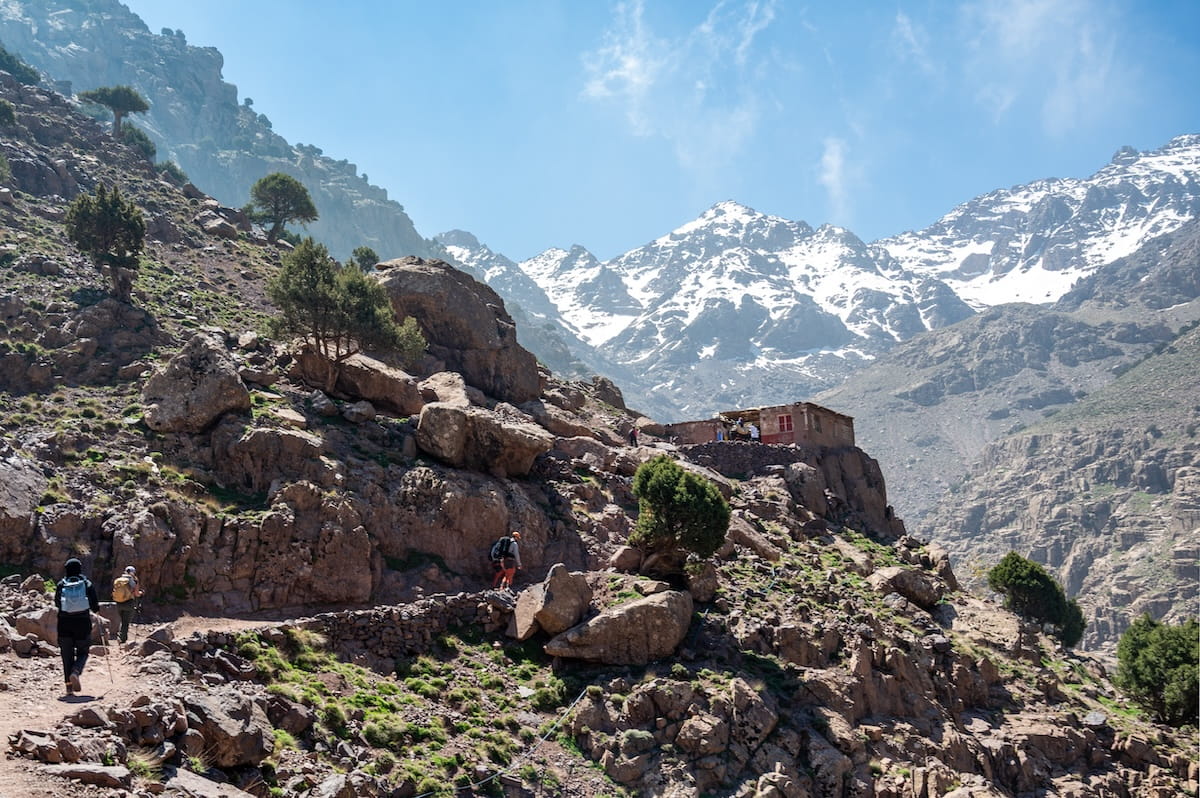
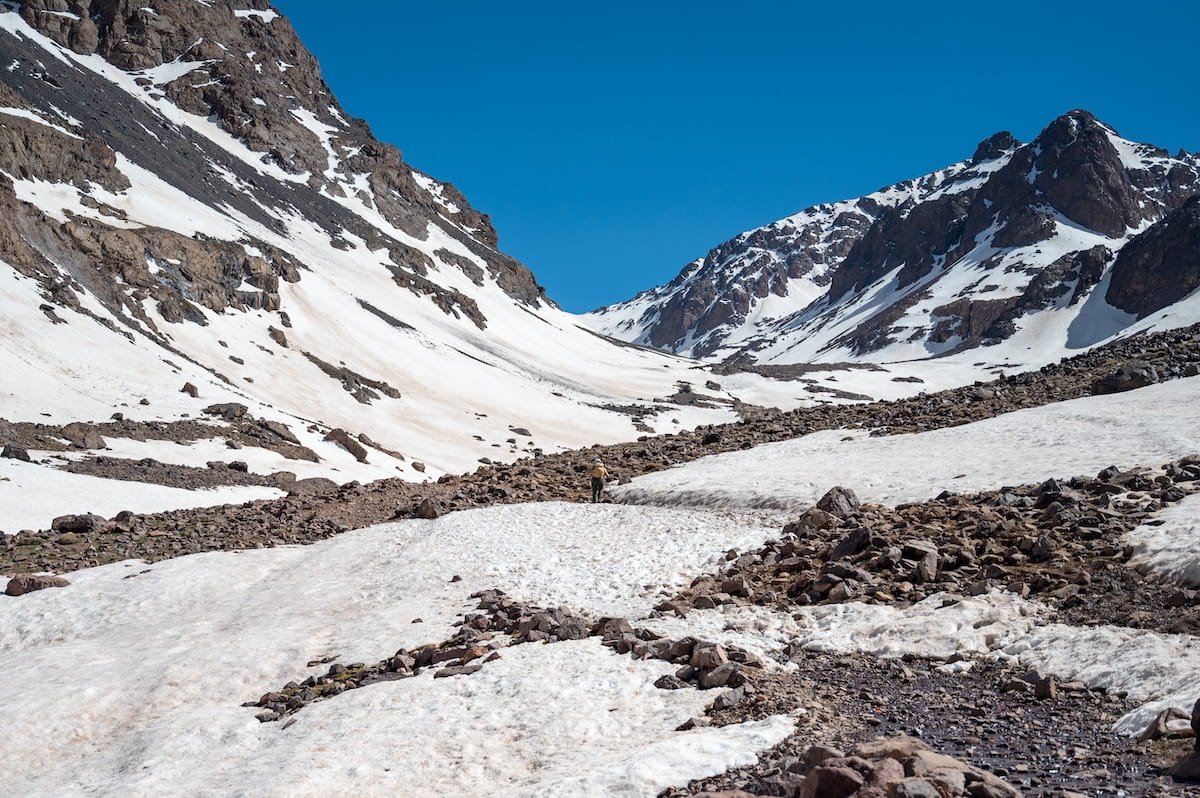
The trail then transitions into uneven rock steps for a steady 1,400-meter elevation gain. Even as you climb into the clouds and pass pockets of snow, the path remains idyllic, lined with ladybugs and butterflies.
You’ll find several small shops along the way selling souvenirs and refreshments where you can stop to take in the views and have lunch before reaching the refuge at 3,206 meters.
Mount Toubkal accommodation
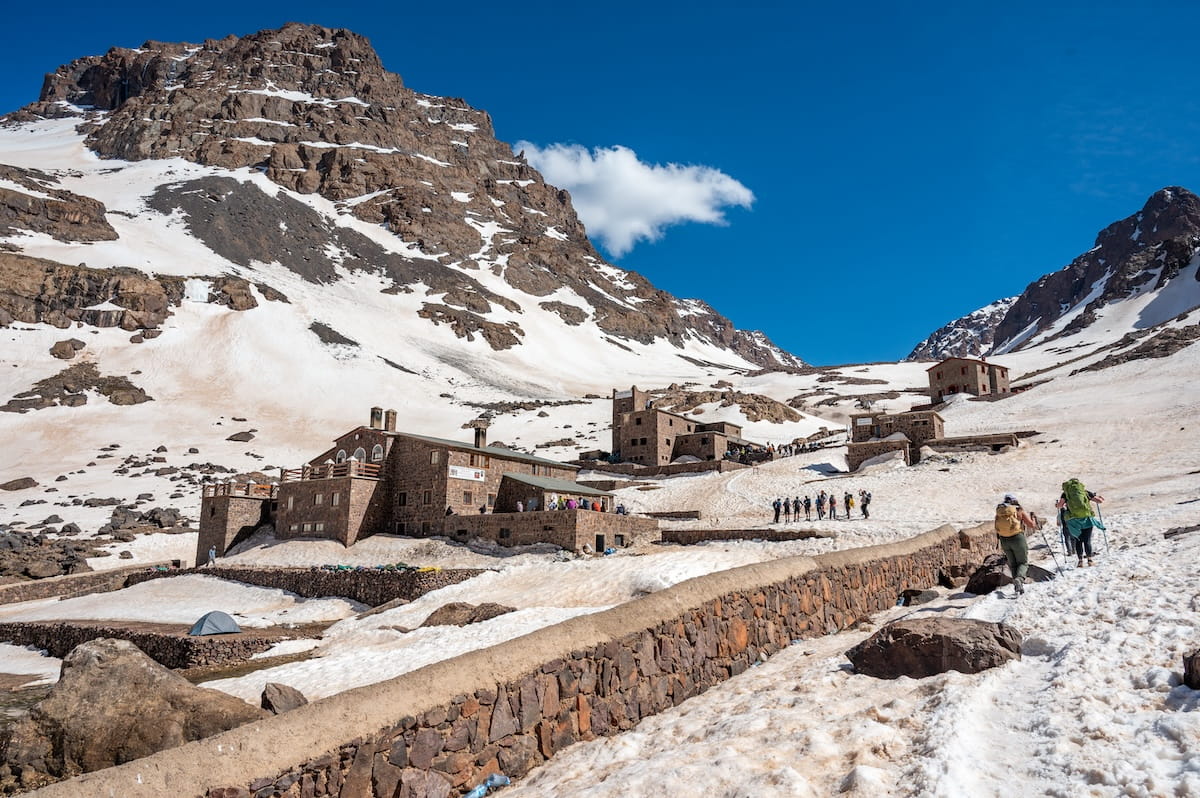
🏨 Mount Toubkal Refuge (3,206 meters). This rustic, stone mountain hut is the final base camp before the summit. Prepare to share a room with other hikers, with dorm sizes varying from 12-27 people (so earplugs are a must!).
The refuge typically shuts off electricity during the day, so it can be dark inside, but you’ll have light again around 6:30/7pm to be able to organize yourself for the morning and eat dinner. Most hikers get up between 2am-4am to begin their ascent up Toubkal, so don’t expect to get a lot of sleep!
Stop #6) Mount Toubkal Summit + Return To Imlil (1 night)
Summiting Mount Toubkal
- Difficulty: Strenuous.
- Elevation Gain: 961 meters.
- Time: About 9 hours of hiking.
This day was the highlight of my entire Morocco itinerary! Yes, it’s hard, but you’ll have stunning views the entire time as you make your way up Mount Toubkal, the highest mountain in North Africa at 4,167 meters!
We wake up at 2am to get ready, eat breakfast, and put on our crampons and helmets. Leaving the lodge at 4am, we use headlamps to navigate the dark snowfields while the stars and the faint glow of other hikers’ lights illuminated the path.
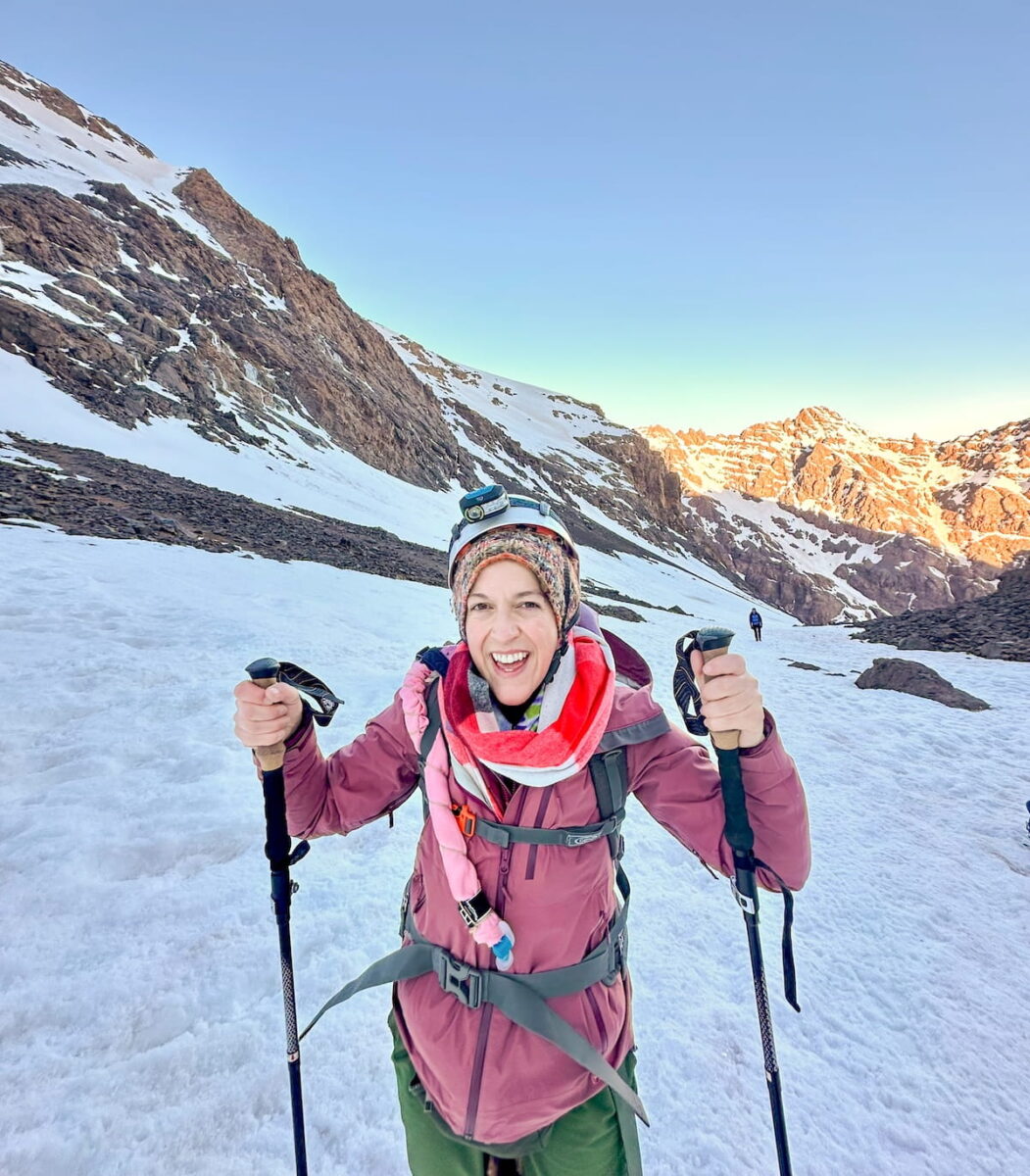
After a few hours, the sunrise begins to color the surrounding peaks, and the terrain shifts from packed snow to challenging loose scree. For me, this is where it really starts to feel challenging, especially with the uneven terrain.
Reaching the Tizi N’Toubkal (Toubkal Pass) at 3,950 meters feels like a false summit because the 360-degree views are already incredible, but the final 45-minute rocky climb to the actual summit is worth the effort.
Reaching the Mount Toubkal summit feels incredible, especially as you look out at the endless Atlas Peaks and realize just how high you are and how far you’ve come. Make sure to get a photo with the metal triangle marking the official top.
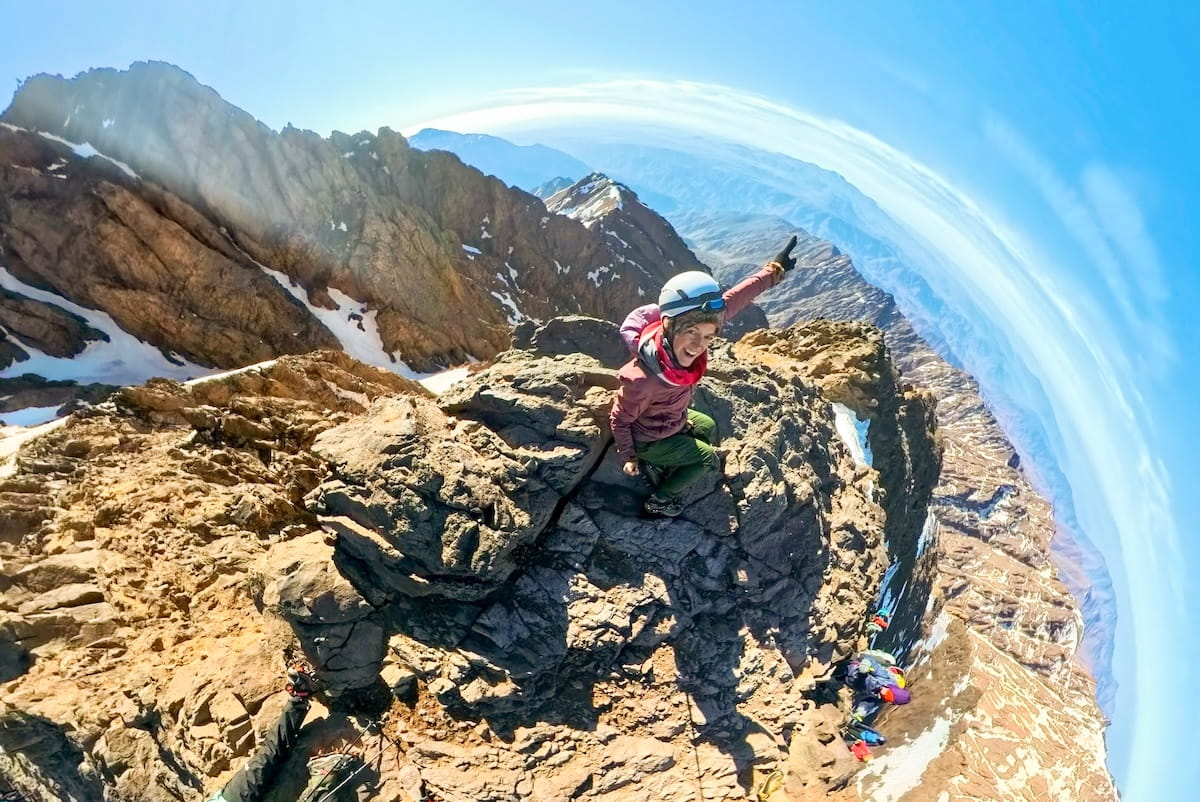
Warning: The descent is harder than the ascent! It’s a long, steep trek back to the refuge for lunch—where sliding down the snow sections was a highlight—before continuing all the way back to Imlil.
By the time you get back to Imlil you’ll be absolutely exhausted, so expect to simply eat dinner and rest.
Imlil Accommodation
🏨 Atlas Imoula Guest House (1,800 meters). This guesthouse is located just a 15-minute walk to Imlil’s main center — far enough way to be peaceful yet close enough to be accessible. The rooms are very comfortable with thick blankets, hot showers, air conditioning, and WiFi. There is also a tasty onsite restaurant (my tagine was delicious) and terrace offering mountain views.
Stop #7) Dadès Gorge (1 night)
About Dadès Gorge
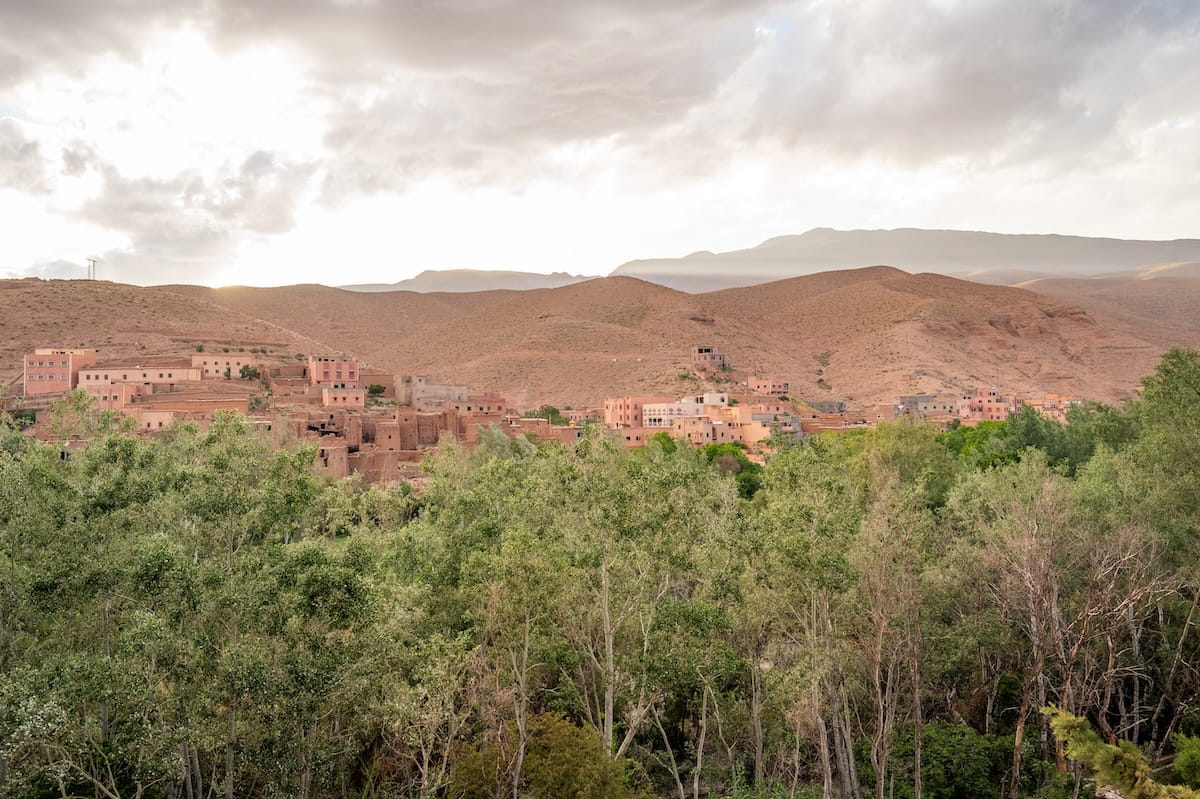
Historically part of an ancient caravan route connecting the Sahara Desert with cities up north, today the Dadès Gorge is known for its otherworldly scenery with red sandstone hills, dramatic rock formations, and crumbling kasbahs.
Depending on the season, you may see nomadic Berbers transporting their belongings by mule as they move between their summer locations in the Atlas Mountains and their winter dwellings in the Sahara. Visiting in early May, I saw this here and in the Todra Gorge (which you’ll visit tomorrow!).
Best stops between Imlil and Dadès Gorge
It’s about a 6.5-hour drive from Imlil to the Dadès Gorge without stops. It’s incredibly scenic, taking you from high Atlas peaks down the hairpin turns of the Tizi n’Tichka Pass, where the landscape transforms into dry cacti-covered plains with ancient ruins and mud-brick towns.
As there are many notable places to stop, I recommend leaving early to make time for:
- Tiziait Barka Cafe: After 5 days of instant coffee along the trail, I was excited to stop here for a real cappucino and a bathroom break with a beautiful view over the Ait Barka Valley. They also have a large Morocco driving map so you can get a visual of your route.
- Tizi n’Tichka Pass: The highest major mountain pass in North Africa (2,260 meters) where you can see serpentine roads cutting through the mountainscape.
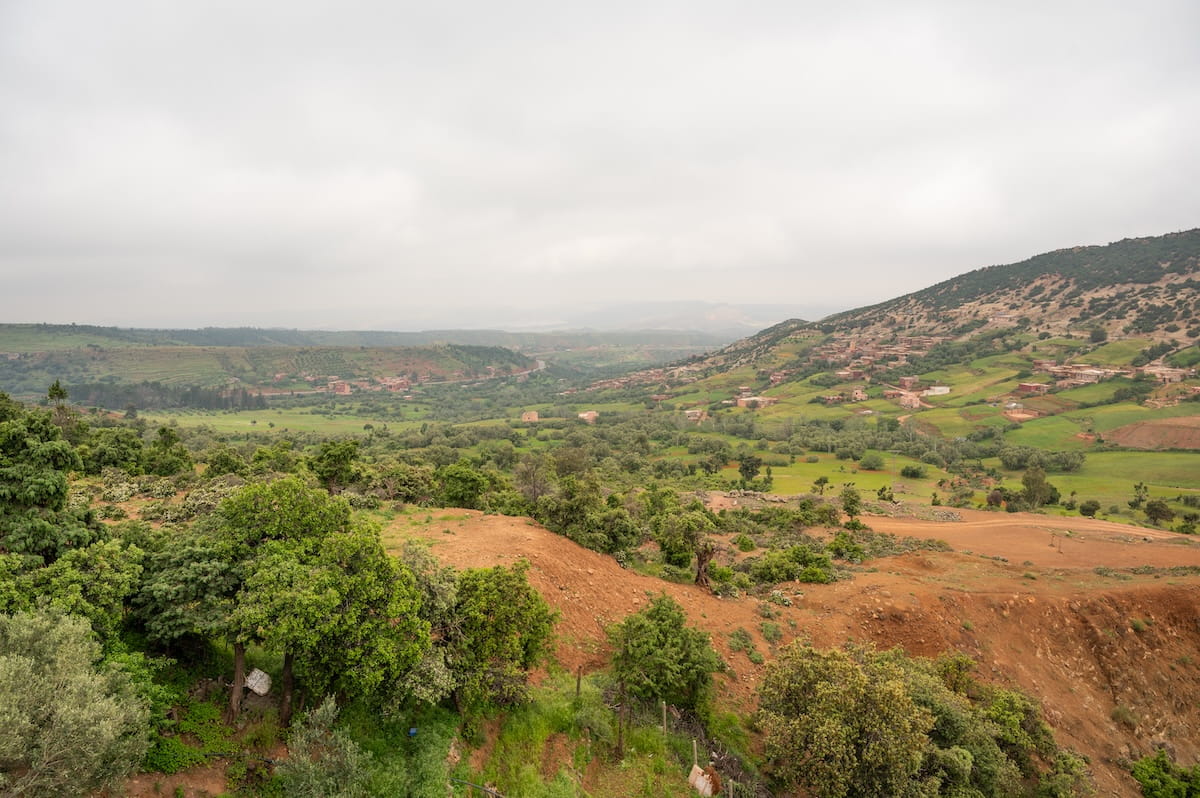
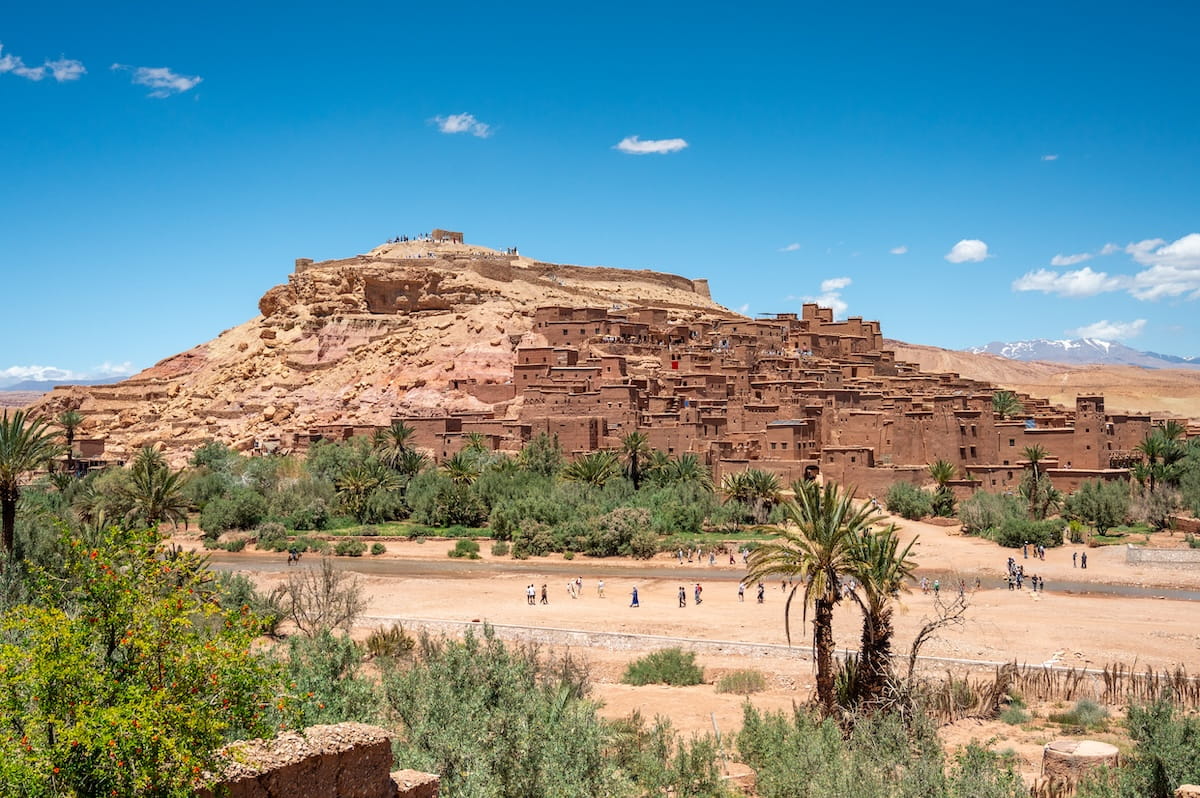
- Ait Ben Haddou: An 11th-century UNESCO World Heritage site renowned for being a striking ‘ksar’ (fortified village) where you can see a traditional pre-Saharan habitat of southern Morocco. Fun fact: it’s also a filming location for Gladiator!
- Ouarzazate: Known as the “Hollywood of Africa,” this movie town was a filming site for The Mummy, Game of Thrones, Lawrence of Arabia, and many other movies and TV shows.
- Valley of the Roses: Near the town of Skoura, the landscape opens into wide plains with rose bushes, and you’ll see women making flower rings and shops selling rose products like soaps, oils, and rose “Champagne” (non-alcoholic).
- Cafe Moussaoui: This notable rest stop serves everything from coffee to Heineken zero to fun snacks to beauty products with party music bumping. While I didn’t eat here, the onsite restaurant has great reviews!
⭐️ Tip: If you skipped the 5-day hike for more time in Marrakech, you can book an Ouarzazate & Ait Benhaddou Guided Day Trip, which also includes cafe breaks and a stop at Tizi n’Tichka!
Things to do in Dadès Gorge
Take photos at Monkey Fingers Viewpoint. This photo spot features rock formations that truly do look like monkey paws. There is also a trail that leads from the parking lot deeper into the gorge if you’d like another perspective.
Go hiking. Opt for a guided trek, like the Valley of the Roses and Dades Hike or a Private Hike to Monkey Fingers Canyon. You can also hike the moderate, 5.2-mile Monkey Fingers Canyon Loop either with a guide or on your own (trail map here).
Book a biking tour. A Dadès Gorge Cycling Tour takes you off-roading through scenic paths, Berber villages, and ancient kasbahs.
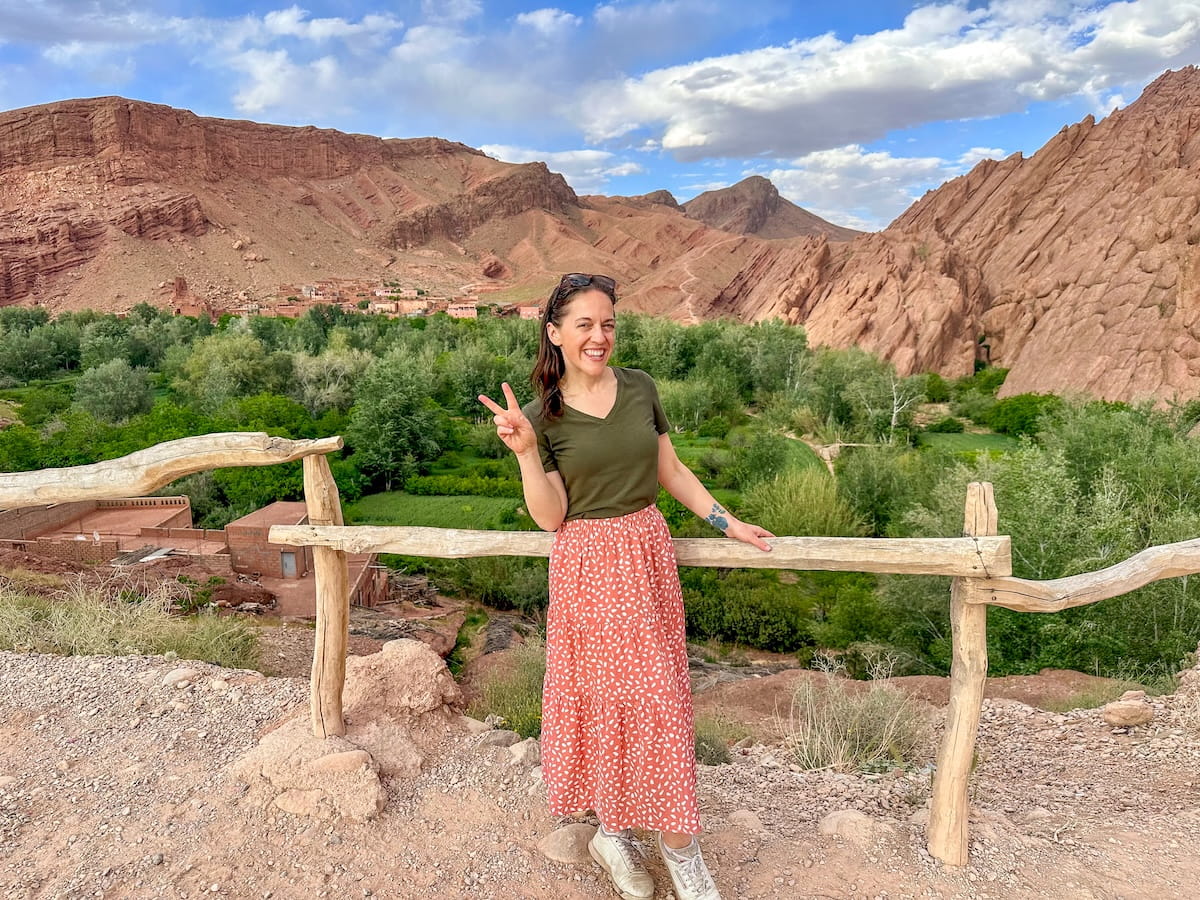
Sip mint tea on an al fresco terrace. There are a bunch of restaurants and cafes with outdoor seating overlooking the gorge, like the plant-filled Rooftop Terrasse Jardin. Ask your riad for nearby recommendations.
Relax at your riad. Book a riad with a rooftop and a pool — like the beautiful Riad Villa Dades — and relax while surrounded by Mother Nature.
Dadès Gorge accommodation
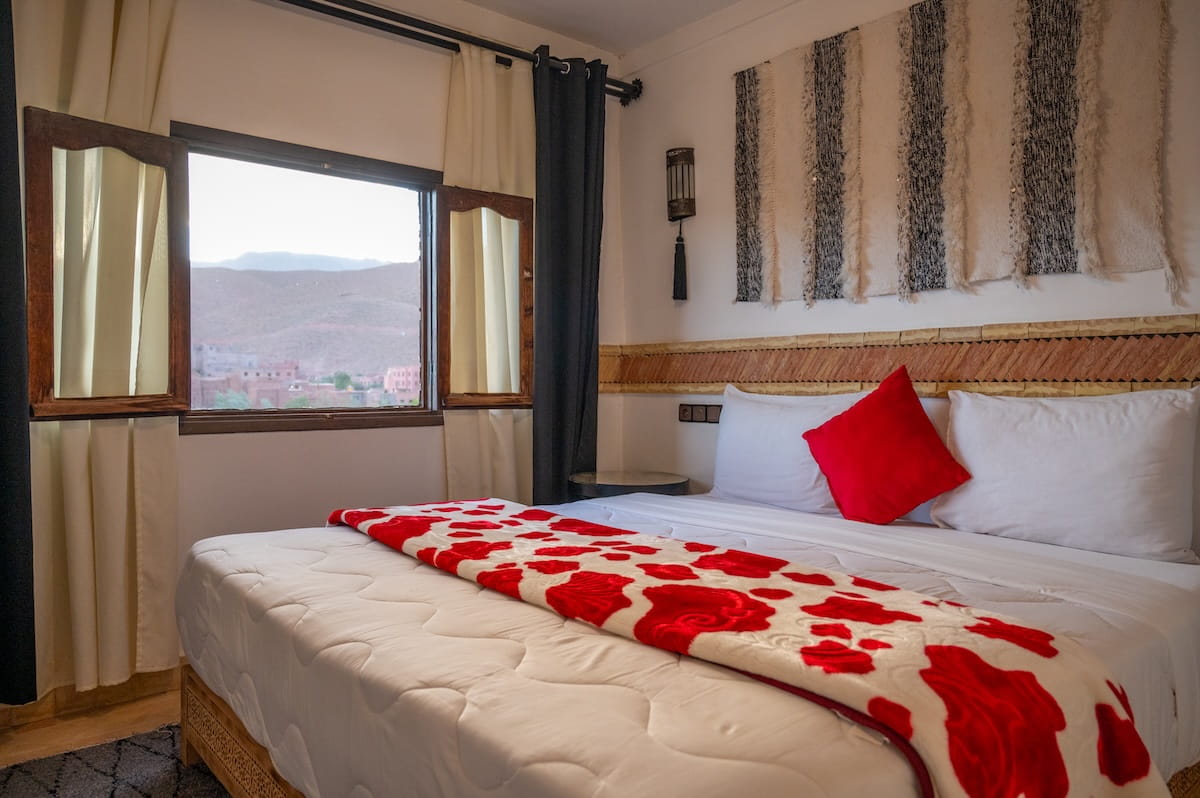
🏨 Riad Villa Dades. This luxury riad is built into the gorge’s red rock. There are cultural touches througout — like Berber rugs and Fes-style vases — as well as a gorgeous rooftop with lounge chairs, a pool, and a view over the gorge. I also loved the walk-in rain shower in my room. Dinner is a multi-course candlelit meal, and they even serve wine and beer (which is not common in Morocco).
Stop #8) Merzouga, Sahara Desert (2 nights)
About Merzouga
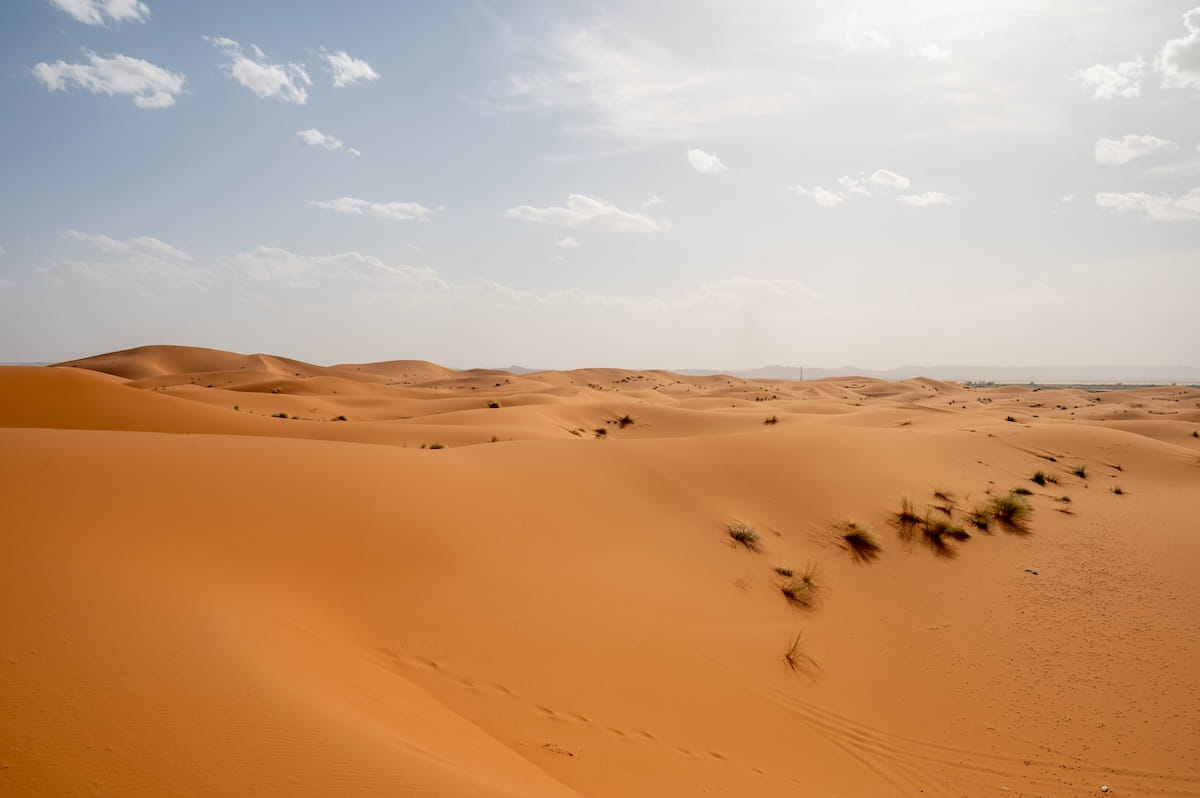
Merzouga is the last town before civilization ends and the Sahara begins. Located near the Algerian border, it is the entry point to Erg Chebbi — an expanse of giant sand dunes that reach heights of up to 150 meters. Walking around, it feels like you’ve landed on Mars!
Best stops between Dadès Gorge and Merzouga
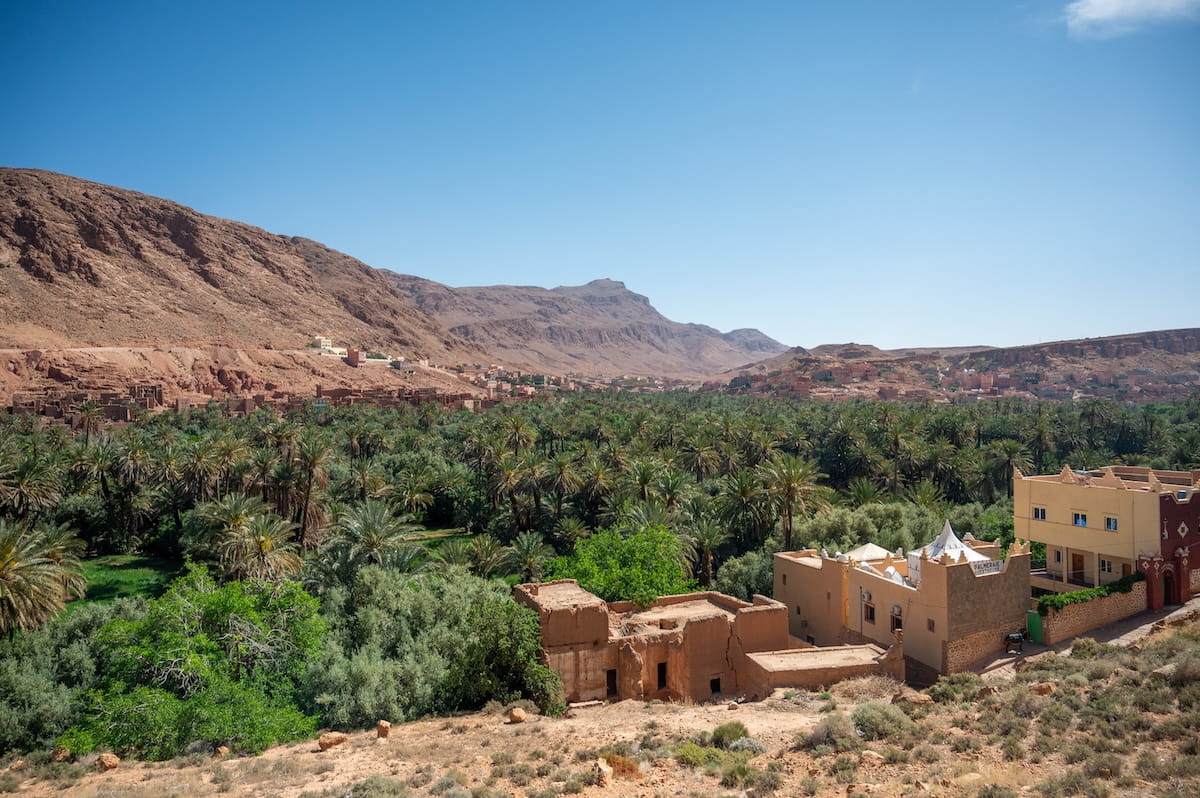
It’s about a 4-hour drive from Dadès Gorge to Merzouga without stops. This stunning drive takes you from rocky canyon walls to palm tree oases and desert towns before reaching the Sahara’s iconic dunes.
As there are many notable places to stop, I recommend leaving early to make time for:
- Panorama Dadès: A roadside overlook just outside the gorge where you can look down at the winding road and canyon below.
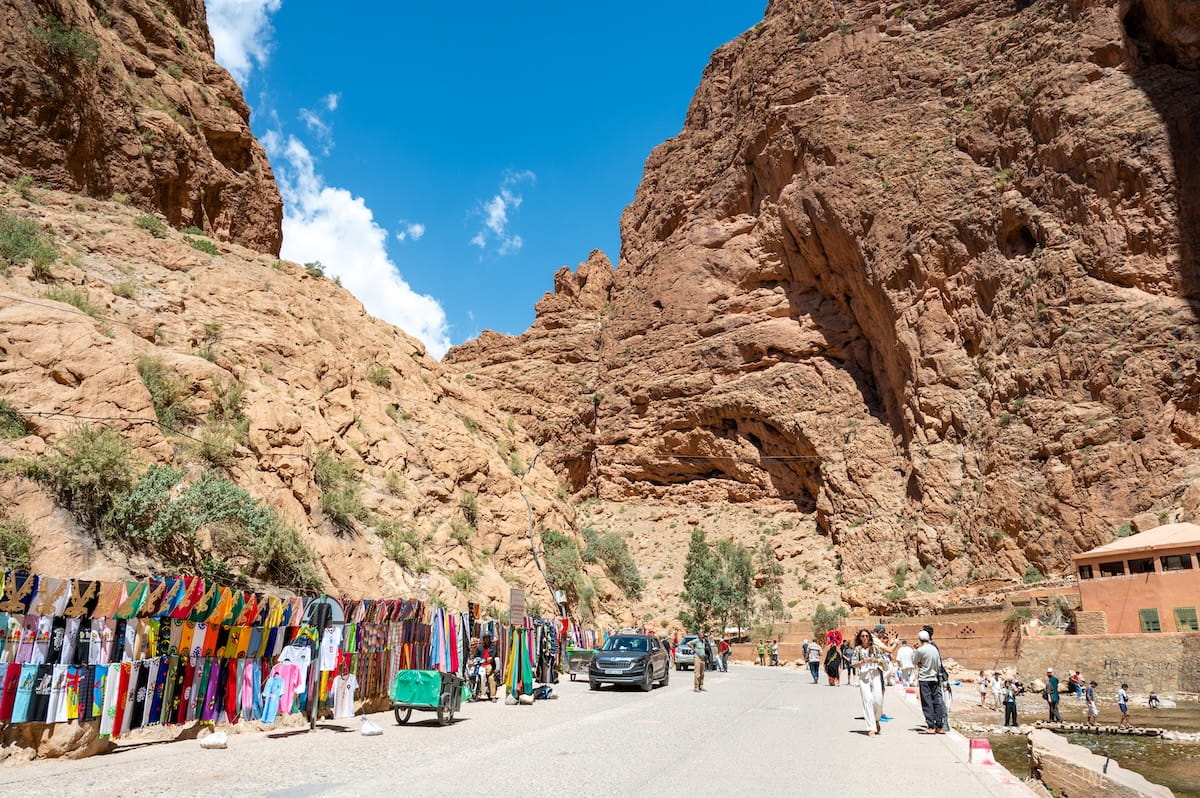
- Todra Gorge & Valley: A massive canyon with limestone cliff walls. While it can feel a bit like Times Square due to all of the vendors selling tourist souvenirs, you’ll also see rock climbers on sheer cliffs and nomadic Berbers walking down from mountain caves to wash things in the river.
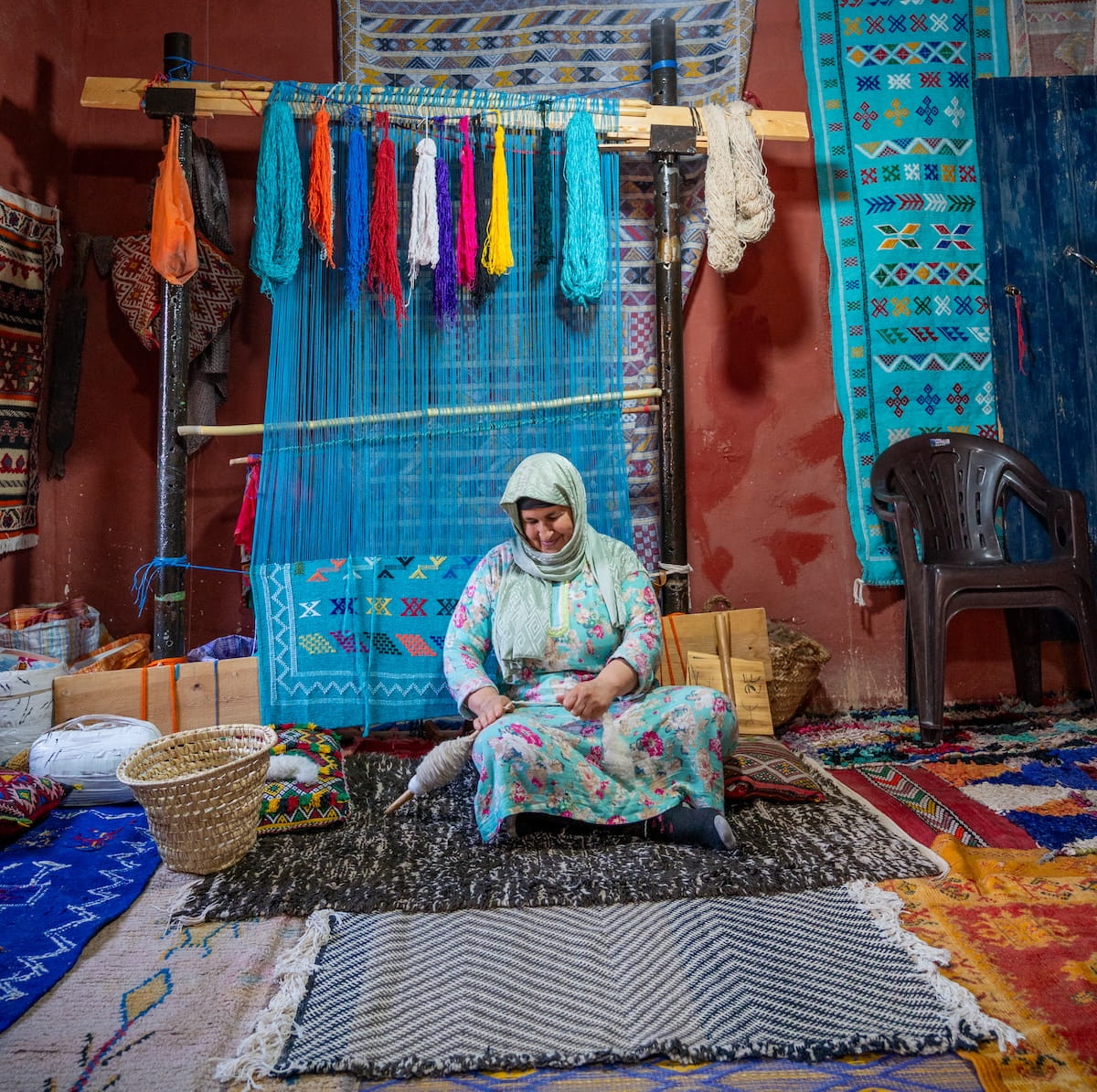
- The Women’s Carpet Association of Todra Valley: Out of all of the carpet places I visited in Morocco, this felt the most authentic — particularly because it’s completely out of sight through a nondescript alley and has no signs (I never would have found it without my driver, Ibrahim!). This cooperative is run by 25 local families where women weave handmade rugs using sheep wool and camel hair colored with all-natural dyes. Sipping mint tea, you’ll learn how each rug is made and what the adorned Berber symbols mean.
- The Sahara Gate: An ornamental stone archway over the highway located about 30 minutes before you reach the dunes, marking the official entrance to the desert region.
Things to do in the Sahara Desert
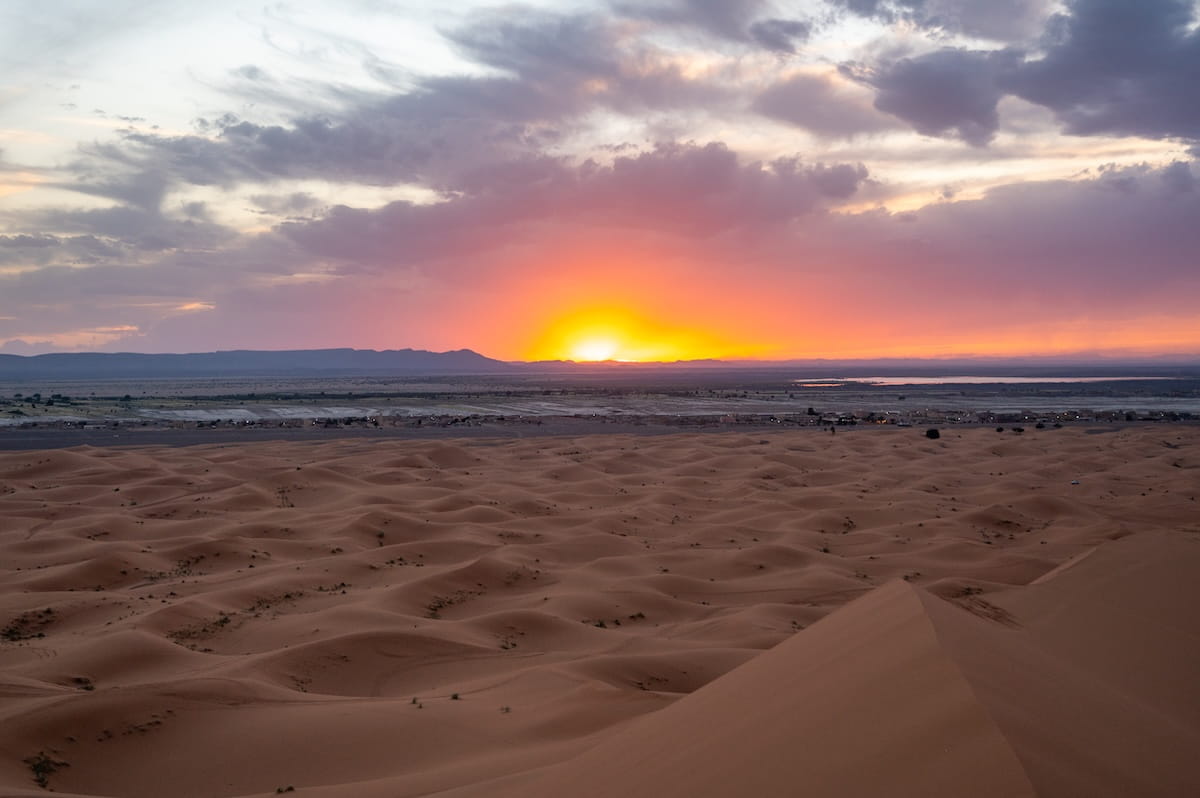
Climb the dunes at sunrise and sunset. Bring your camera for this one!The dunes look totally different depending on the time of day because of how the shadows fall, though they are always gorgeous backed by distant mountain ranges. While sunset is when everyone goes out, you’ll have the place practically all to yourself at sunrise.
Go sandboarding. Another fun way to experience the dunes is sandboarding, which is similar to snowboarding, but in the sand. Here are some tour options.
Visit Merzouga Lake. Also known as Dayet Srij, this lake attracts lots of bird life, including at times flamingos. Since it sometimes dries it, the lake will suddenly appear in the desert, making it a very unique attraction.
Explore the Hassilabied Village Gardens Oasis. Located about 15 minutes from Merzouga, this community garden is a network of palm shaded paths where you can see the ancient khattara underground water channels and watch local farmers tending to plots of alfalfa, olives, and vegetables.
Campfire & live music. Most camps — including Sanmao Desert Luxury Camp, where I stayed — set up a central fire pit in the evening where staff play traditional Berber music.
Book camel rides with care
While riding camels in the Sahara Desert is a dream for many travelers, it can also promote animal cruelty. During my time in Merzouga, I saw camels in rough shape with split ears and ripped rope coming out of their nose. I also saw a camel guide aggressively stomp on a camel’s leg when it yelled out.
If you decide to do this activity, make sure to do in-depth research when choosing an operator. For instance, while I didn’t use this company myself, Walking with Nomads has a page detailing how they treat and care for their camels.
Avoid desert 4×4 tours
While renting quads or booking a 4×4 tour is a popular way to see the dunes, irresponsible off-roading causes severe erosion, destroys fragile desert plants, and disturbs wildlife habitats. The loud nature of the bikes is also disruptive to local communities.
I can attest to the noise. While sitting on the dunes at sunset, an endless parade of riders zoomed over the sand, the bikes and their shouts adding a ton of noise pollution to the otherwise tranquil scene.
Merzouga accommodation
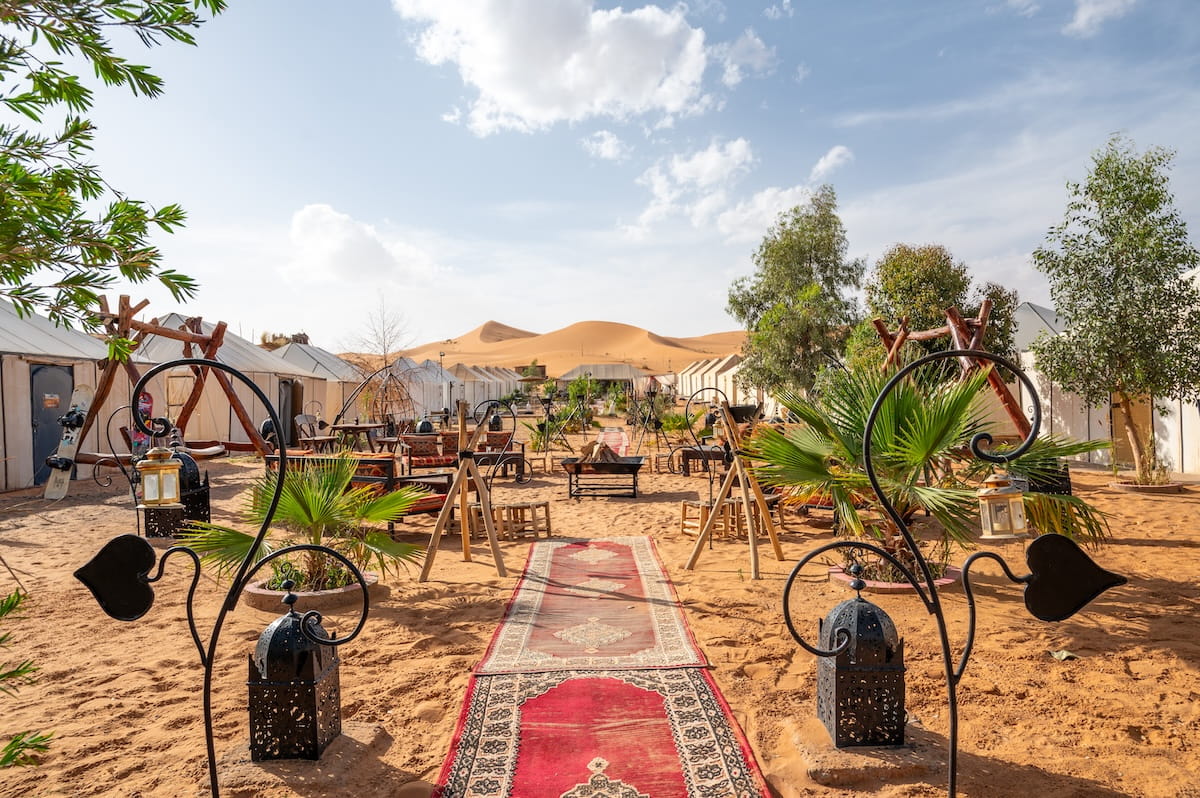
🏨 Sanmao Desert Luxury Camp. This hip camp sits within the Sahara dunes and offers clean and comfortable tents with private hot showers and A/C (make sure your tent has this, as you’ll want it in the warmer months!). The vibe is trendy, with lots of plants and Instagrammable decor. In terms of food, expect delicious multi-course dinners that easily accommodate vegetarians and a large self-serve breakfast buffet.
Stop #9) Fes (2 nights)
About Fes
Fes (also spelled Fez) is one of Morocco’s oldest imperial cities, home to the University of al-Qarawiyyin, the oldest continuously operating university in the world, and a massive 9th-century Medina that feels like stepping back in time. Along with historic experiences, you can also find modern riads, rooftop terraces, and restaurants.
Best stops between Merzouga and Fes
It’s about a 7-hour drive from Merzouga to Fes without stops. This gorgeous drive takes you from the dunes of the Sahara to the date-palm-filled Ziz Valley, before climbing into the apple orchards of Midelt Province, passing the wild Barbary macaques of Azrou forest and finally winding through the Swiss-style architecture of Ifrane.
- Erfoud: Known as a major fossil town, you can stop at Morabit Marbre Fossiles Mineraux to learn about the area’s prehistoric history. They also sell gems, geodes, and excavated fossils carved into everything from geodes to marble housewares.
- Note: I’ve seen some forums online saying many local shops don’t sell 100% genuine fossils. I’m not a fossil expert, so do your own research. Either way, it’s an interesting place to learn about the area.
- Ziz Valley Overlook: This is a great stop to look down over thousands of palm trees cutting through the dry canyon, known for producing the region’s famous and delicious dates.
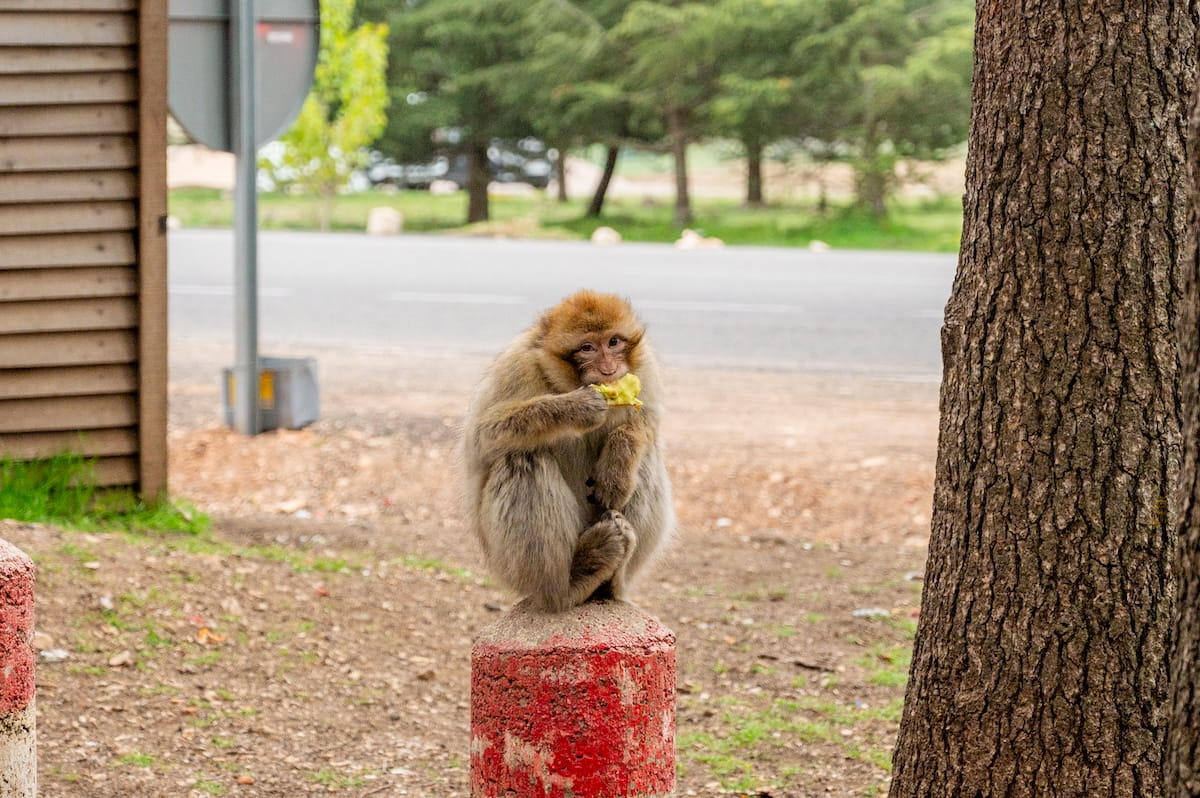
- Azrou Cedar Forest: This wooded park is home to families of wild Barbary macaques. You’ll see them right in the parking lot, along the roadside, and in the forest.
- Warning: As soon as you get out of your car, locals will pester you incessantly to buy peanuts and tomatoes to feed the monkeys. Just be firm with your “no.”
- Ifrane: Known as the ‘Switzerland of Morocco,’ this upscale mountain town feels European with sloped red roofs, clean streets, and a cool climate.
Things to do in Fes
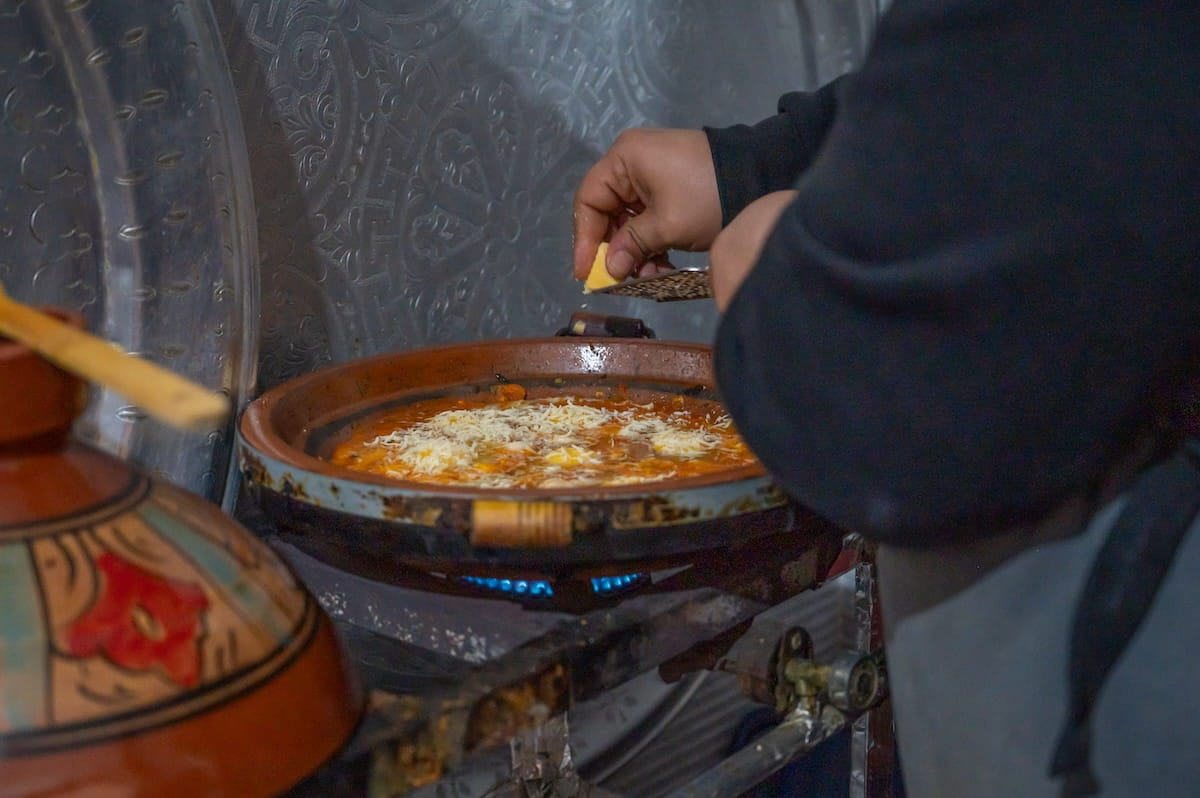
Do a cooking class. A Souk Tour and Traditional Home Cooking Class was the best thing I did in Fes! After sipping mint tea and choosing your menu (including vegetarian options), you’ll shop the local produce and meat souks for ingredients. Back in the kitchen, it turns into a hands-on cooking experience complete with chopping, simmering, stirring, and adding vegetables and spices. Afterward, you’ll enjoy a meal with your fellow chefs. Tip: I highly making the Tagine Taktouka, my favorite dish we made!
Learn the art of Fes pottery. Fes is renowned for its cobalt blue and white ceramics as well as Zellige terracotta tilework, which is hand-painted and fired using traditional 14th-century methods. You can immerse yourself in this part of the city’s heritage through experiences like:
Take a walking tour. There are loads of inexpensive Fes walking tours, like this Guided Walking Tours of the Historic Medina, that will give you an overview of the city and take you to the main sites. You’ll also learn fun facts — like that the Fes Medina is the world’s oldest and largest urban car-free urban area!
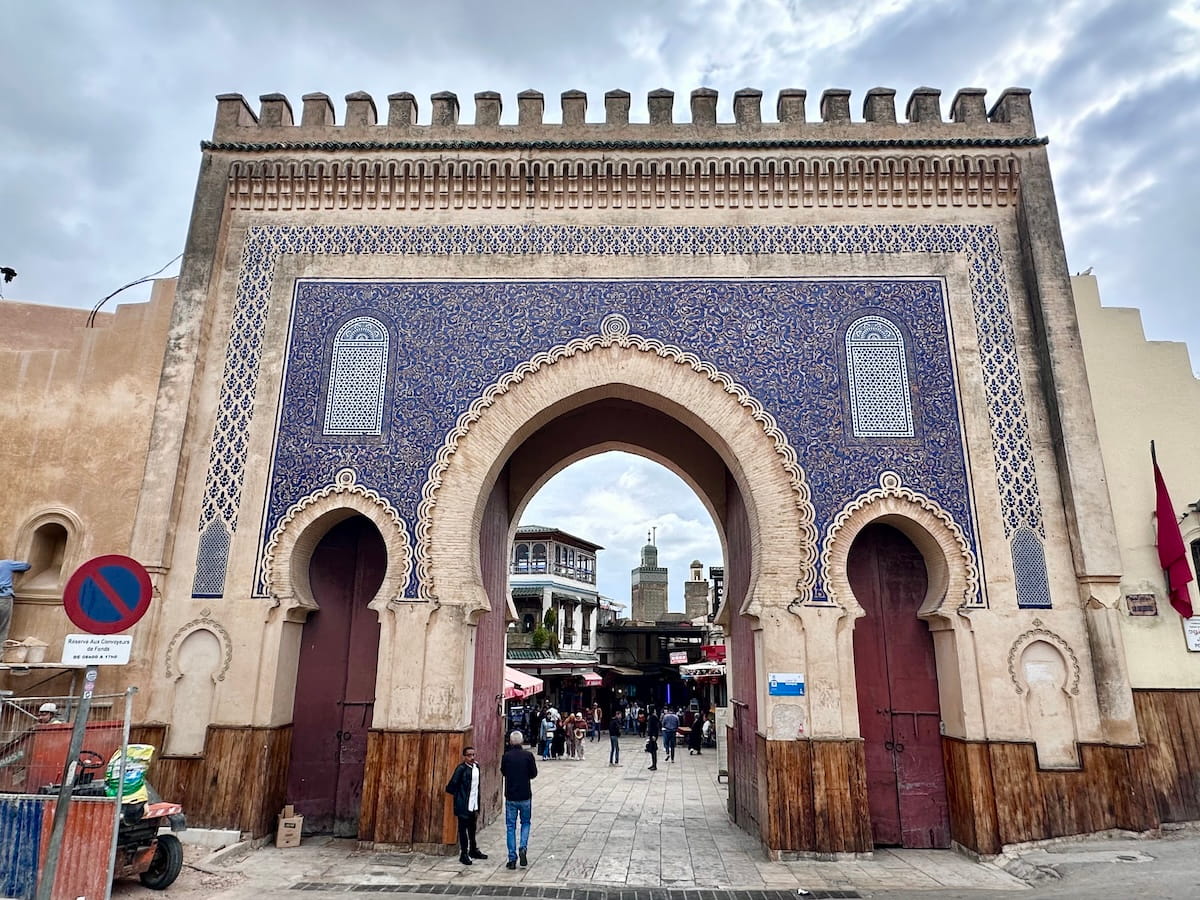
Walk through the Blue Gate (Bab Boujloud). This intricately tiled Moorish archway is the main western entrance into the old medina. While the outside features Fes’ signature blue, the inside features green, the traditional color of Islam.
Wander the Medina. Founded in the 9th century, stroll the UNESCO-listed Medina’s narrow maze of 9,000 alleys — some quiet, some chaotic — filled with food stalls, shops, and cafes. It’s sensory overload, as you’ll walk past fresh bread, fragrant spices, and sweet candy being cut, before hitting something pungent and then walking past leather purses, wedding dresses, and mosaic plates.
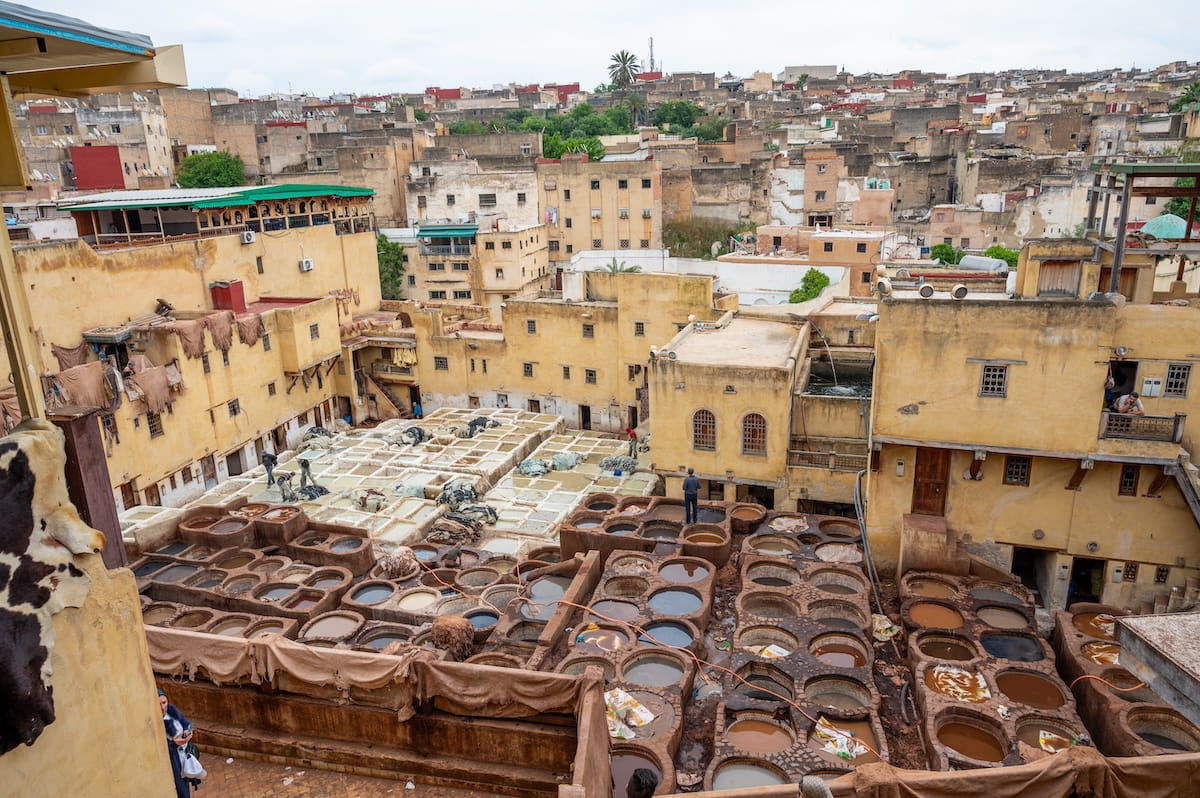
See the Chouara Tannery. At Fes’ famous open-air tannery, you’ll see workers use leather-making methods dating back to the 11th century. You’ll see workers standing knee-deep in stone vessels filled with limestone and pigeon droppings to wash and prep the hides before treating them with all-natural dyes like indigo and saffron.
⭐️ Tip: It is best to visit Chouara Tannery with a guide to avoid common scams or being hassled for money by people on the street. This way, you’ll also learn more about what you’re seeing!
Visit the Bou Inania Madrasa. This 14th-century madrasa (Islamic educational institution) showcases gorgeous Marinid architecture with green roof tiles, carved cedarwood, detailed stucco work, and mosaic tiling. Because it uniquely doubled as a fully functioning place of worship, it is the only school in Fes to feature its own minaret — a prayer tower typically reserved for standalone mosques. Price: 20 MAD.
Where to eat in Fes
Souk Tour and Traditional Home Cooking Class. Mentioned above, you will be stuffed when you leave this class.
Restaurant Dar Tresor. This relaxed rooftop eatery offers a view over the city and served the most delicious vegetable couscous of my entire trip, especially as it was topped with sweet raisins. It’s located inside a riad with bright murals and art too.
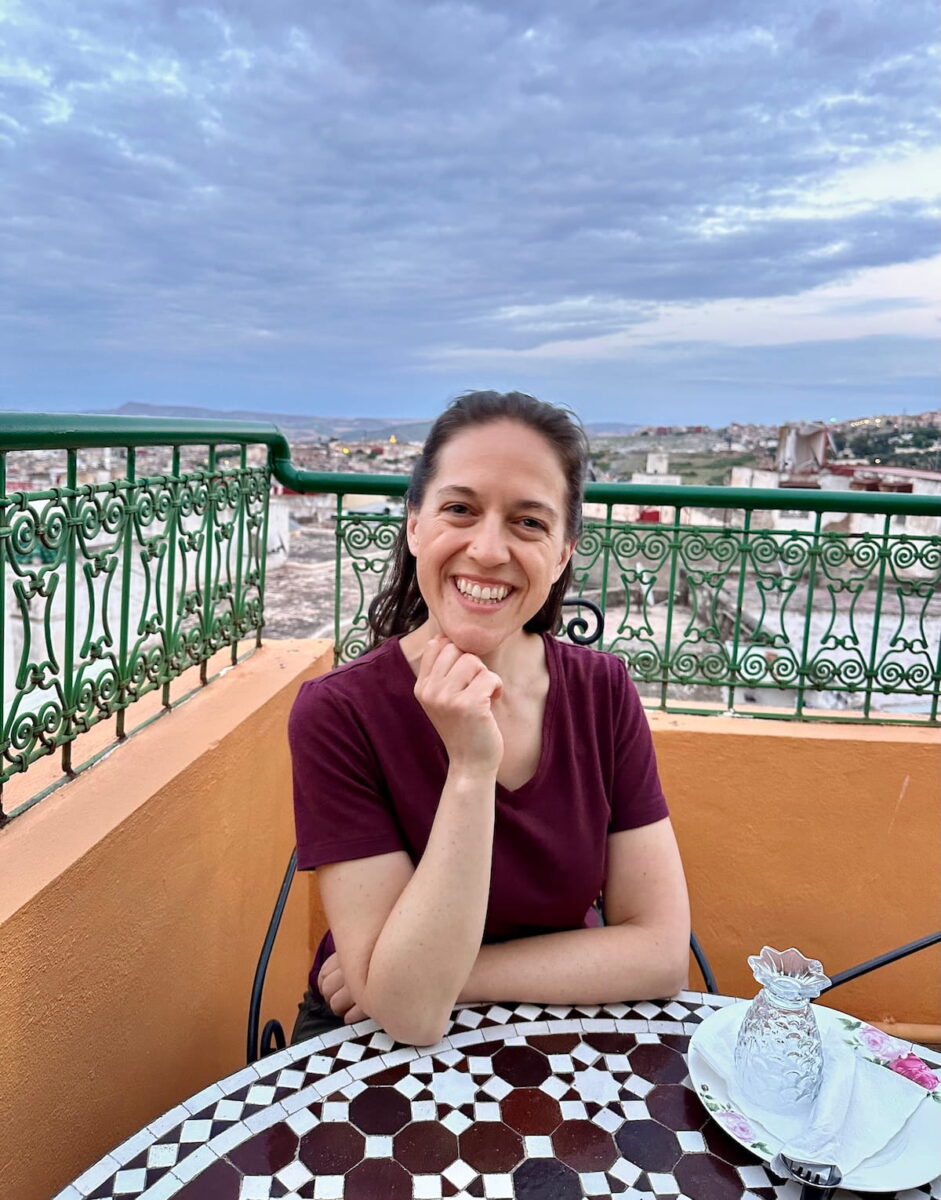
L’Amandier (at Palais Faraj). This high-end rooftop restaurant serves upscale Fassi (traditional Fes-style) cuisine. Try the Melting Burrata with Fes tomatoes or the Fes-style Seafood Pastilla.
Fes accommodation
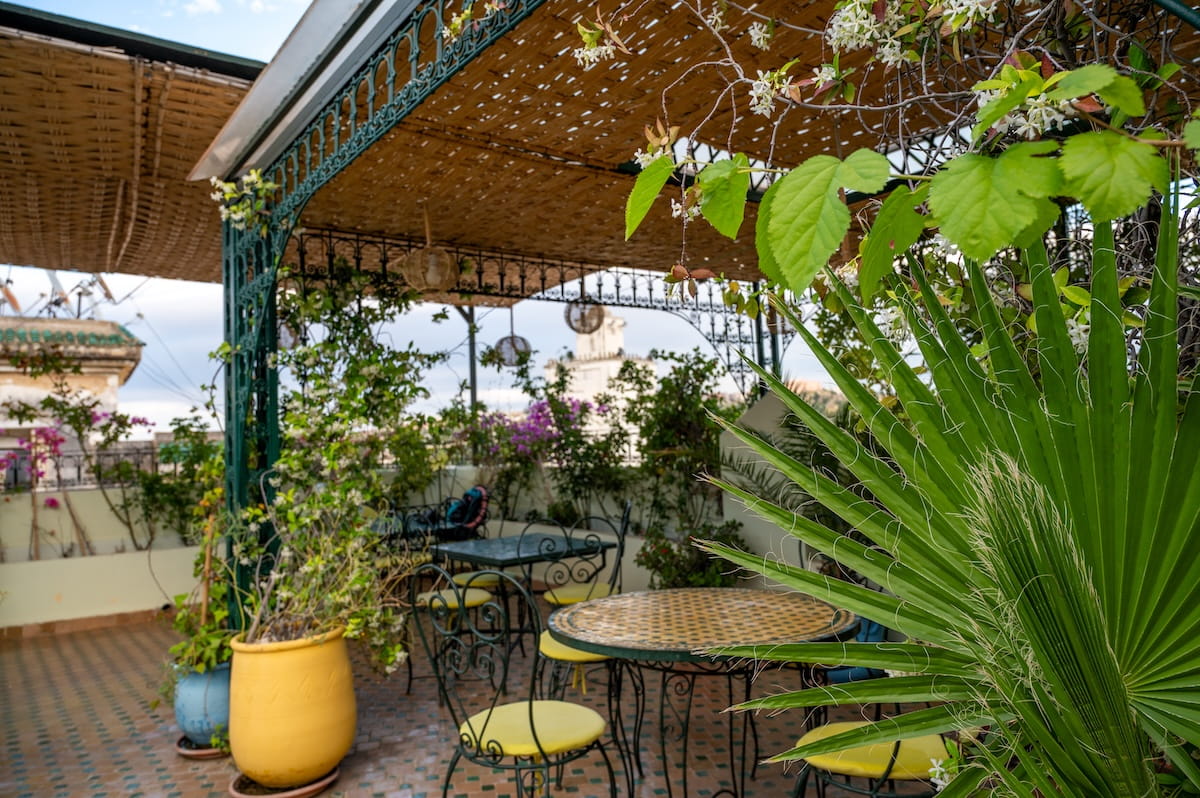
🏨 Riad Dar Medina Fes. Located in the Medina in the quiet Ziat neighborhood, this traditional riad features ten modern rooms with air conditioning, tiled tubs with rain showers, and super comfortable beds. My favorite part of the stay was enjoying a generous included breakfast on their flower-filled rooftop (you can also pre-book dinner here). The riad is also part museum, with historic artifacts showcased throughout.
Stop #10) Casablanca (1 night)
About Casablanca
You’ve probably heard of Casablanca (often called “Casa” by locals) from the iconic namesake film. This oceanfront city is the largest in Morocco, feels more modern than Fes and Marrakech, and offers diverse dining, French-Colonial Art Deco architecture, and plenty to do and see. Plus, it has Morocco’s biggest international airport for the trip home!
Getting from Fes to Casablanca
If flying round-trip to and from the same city is better, you can drive the 7 hours back to Marrakech for a final night; however, if you’d like to add Casablanca to your Morocco itinerary, it’s an easier 3.5-hour drive — and allows you to add another location to your route.
In terms of transportation, if you’ve had a private driver the entire time, this will be the easiest way to get there. That said, because these are major cities, you can also take the train.
Either way, I wouldn’t make any stops as you’ll want to maximize your limited time in Casablanca.
Things to do in Casablanca
Hassan II Mosque. This waterfront mosque is one of the few open to non-Muslims, and is known for its retractable roof and 210-meter minaret. Guided tours are mandatory, so here are a few top-rated options:
- 🕌 Casablanca: Private Guided Tour with Hassan II Mosque Ticket
- 🚶♀️ Hassan II Mosque and Jewish Museum Guided Tour
- ✨ Hassan II Mosque & Casablanca City Highlights Tour
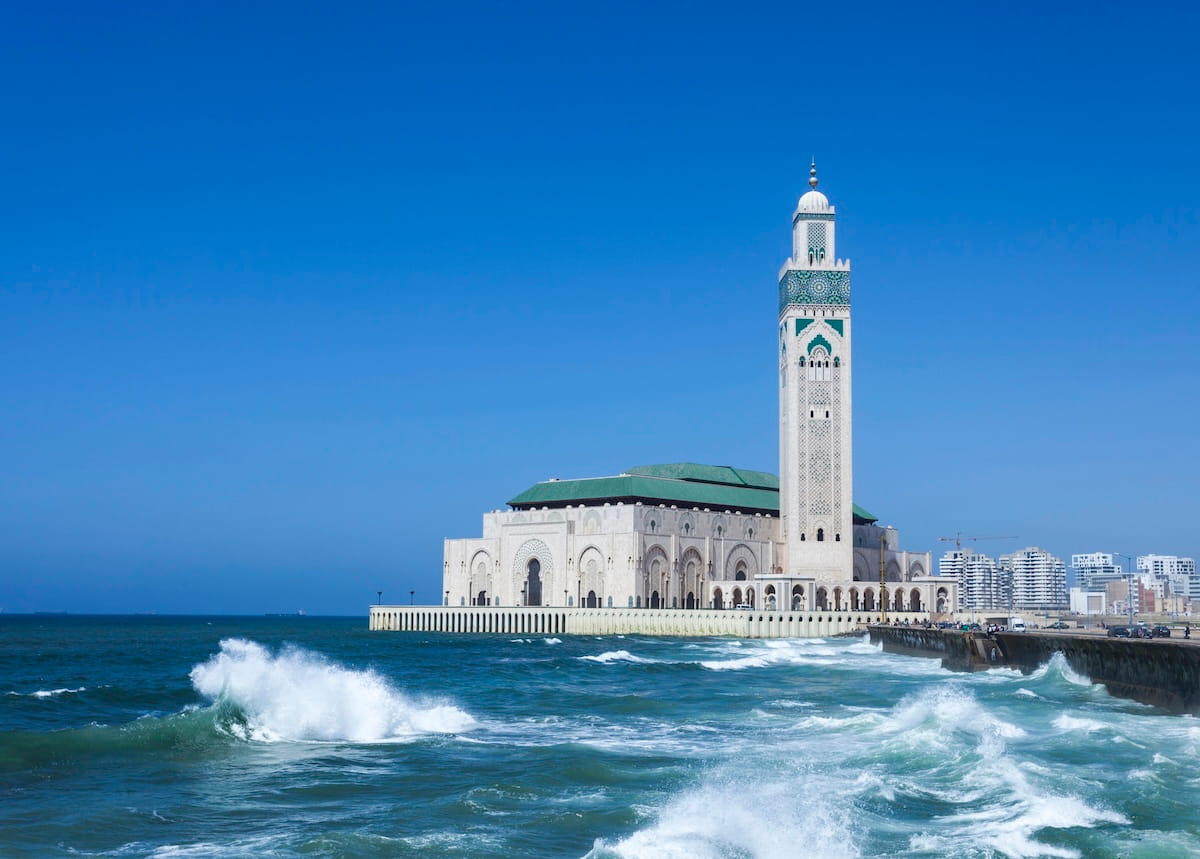
Walk the Corniche. This beachfront boardwalk in the Ain Diab neighborhood is perfect for a sunset stroll to watch Atlantic Ocean waves lap up against the mosque. This is also where you can find beach clubs like Tahiti Beach Club and Gaia Beach Casablanca.
The Habous Quarter (New Medina). Built by the French in the 1920s, this Medina is cleaner and quieter than Fes, with beautiful arches and loads of shops.
Take an architecture walk. Walk down Boulevard Mohammed V to see beautiful buildings blending a variety of architectural styles like French Art Deco and Neo-Moorish.
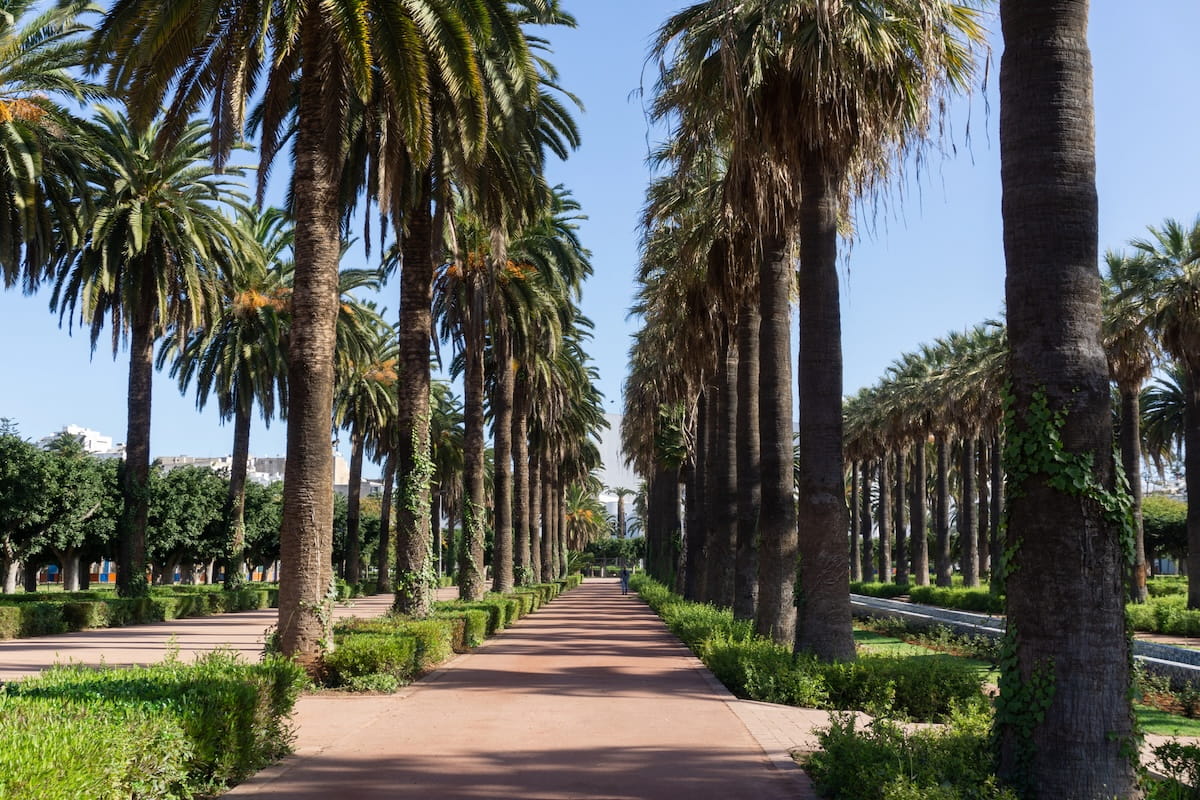
Arab League Park (Parc de la Ligue Arabe). This 30-hectare (74-acre) park features beautiful palm-lined paths and grand fountains. Enjoy the scenery before walking over to the nearby Art Deco-style Sacred Heart Cathedral, a former church dating back to 1930.
Where to eat in Casablanca
Rick’s Café. A recreation of the bar from the film Casablanca, this spot is touristy but the 1940s decor, craft cocktails, and live jazz make it worth — as do the Champagne oysters and goat cheese with figs!
Café Le Crépuscule. Located on the Corniche, this terrace crêpe cafe features an unobstructed view of the beach and is one of the best places to watch the sunset over the Atlantic.
Dar Dada. Enjoy dinner with a live show at this riad restaurant, which serves Moroccan food that goes beyond the simple tagine and couscous dishes you find at most places. Fill up on sea bream filet or slow-cooked lamb tagine with prunes, apricots, and almonds while also enjoying live music.
Casablanca accommodation
🏨 Art Palace Suites & Spa. Located in Casablanca’s hip Gauthier neighborhood, you’ll be near plenty of cafes, shops, and restaurants. The hotel is clean and comfortable with themed suites, onsite dining, a swimming pool, and a spa where you can end your trip with a traditional hammam.
Shorter 12 Days In Morocco Itinerary
If you only have 12 days in Morocco, I’d recommend removing the first two days of the hike to make the itinerary:
- Marrakech (2 nights)
- Imlil (1 night)
- Mount Toubkal Refuge (1 night)
- Mount Toubkal Summit + Return To Imlil (1 night)
- Dadès Gorge (1 night)
- Merzouga, Sahara Desert (2 nights)
- Fes (2 nights)
- Casablanca (1 night)
Shorter 10 Days In Morocco Itinerary
If you only have 10 days in Morocco, I’d recommend further culling the itinerary by cutting 1 night in the Sahara and the Casablanca stop. You’ll want to book a late afternoon or evening flight from Casablanca to give yourself time to do the 3.5-hour drive from Fes to the Mohammed V International Airport.
- Marrakech (2 nights)
- Imlil (1 night)
- Mount Toubkal Refuge (1 night)
- Mount Toubkal Summit + Return To Imlil (1 night)
- Dadès Gorge (1 night)
- Merzouga, Sahara Desert (1 nights)
- Fes (2 nights)
Alternative Non-Hiking Route With Essaouira
While summiting Mount Toubkal was the main highlight of my trip, I realize not everyone loves hiking as much as I do. 😅
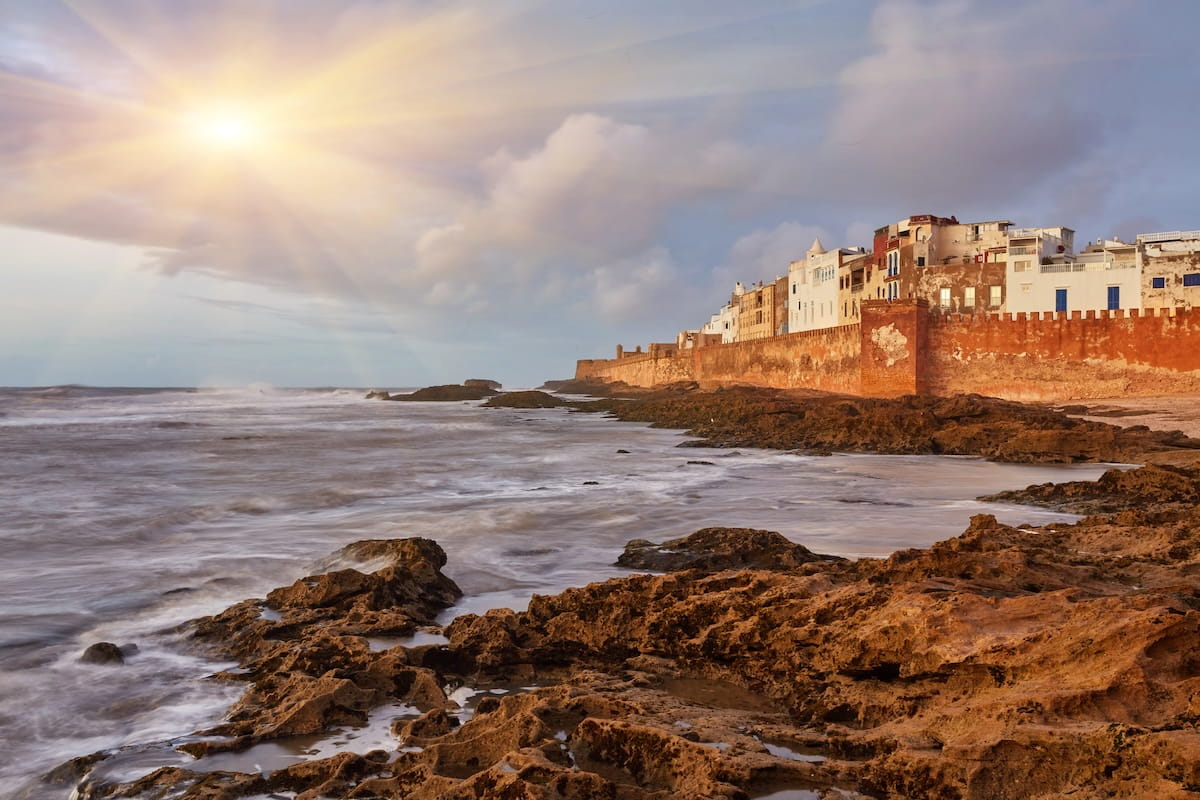
One idea is to swap the Atlas trek for Essaouira. Located just 3 hours from Marrakech, this port city offers a relaxed Medina, delicious seafood, and beautiful Atlantic Ocean views — and it’s a popular spot for kitesurfing.
This would make your stops:
- Marrakech
- Essaouira
- Dadès Gorge
- Merzouga, Sahara Desert
- Fes
- Casablanca
Tips For Visiting Morocco
Now that you know where to go and what to do in Morocco, let’s go over some important tips to keep in mind:
Avoid common scams
While Morocco is a safe place to visit, you will likely encounter these common tricks in the major cities:
- The “Road is Closed” Scam: Locals may tell you a street is closed, especially in the medinas, to redirect you to their shop. Just keep walking.
- The “Unsolicited Guide” Scam: Avoid people offering to lead you places for “free,” as they will almost always demand a tip once you arrive.
- The “Henna” Trap: Be wary of women in Jemaa el-Fnaa who grab your hand to start a design without consent, as they’ll demand money afterward.
- The “Animal Photo” Trap: Don’t let anyone place a monkey or snake on you for a photo. Not only are these animals usually treated terribly, but you’ll be hassled for payment immediately.
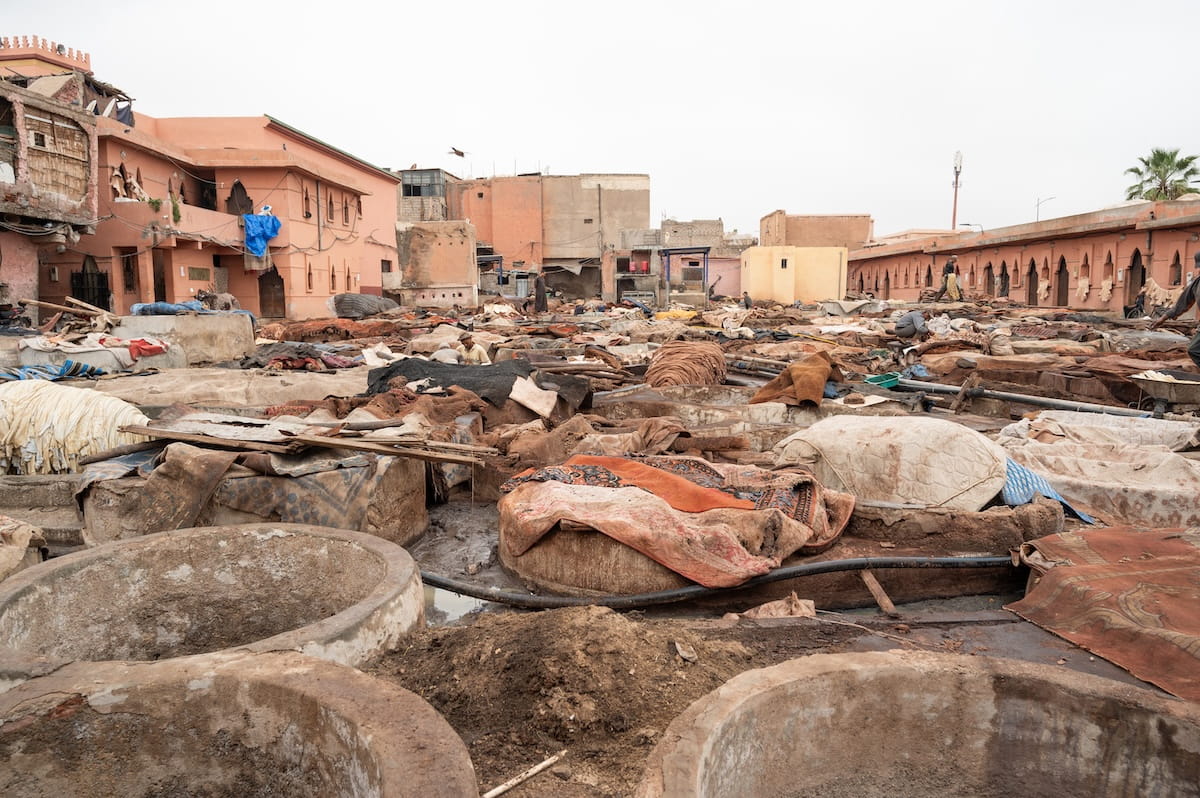
- The “Free Tannery Tour” Scam: Be wary if you’re offered a free look at the tanneries, particularly the Marrakech Tannery, as it’ll likely end in an intense sales pitch.
My story: That last scam happened to me and a friend. We’d walked up to the tannery in Marrakech just to see it, when someone started telling us about it. We followed him, thinking he was just sharing some information as we never requested a tour, though we ended up getting pushed to all the local shops and then were told (very aggressively) that we owed 200 MAD. His tone was pretty frightening, so we paid and promptly left.
Don’t drink the tap water
While the tap water isn’t safe for tourists to drink, you can get large bottles of water everywhere for about 10 MAD (sometimes even less!).
If you want to avoid plastic waste, opt for a filtering bottle like the LifeStraw Go, which is what I use. You’ll be able to safely drink water from the tap and even outdoor sources like streams and rivers.
Bring an ATM card and cash
Personally, my debit card didn’t work at all in Morocco, so it may be worth calling your bank before your trip.
Luckily, I had brought $300 in cash, which was just enough to get me by. Keep in mind, many places in Morocco don’t accept credit card — including many surprising places like popular hotel restaurants.
Tip for good service
Tipping is a part of Moroccan culture. Personally, here is how I calculated tips:
- Restaurants: 10%
- Hotel porters: 10–20 MAD per bag
- Private tour guides: 10%
- Private drivers: 100–200 MAD per day for multi-day trips
- Drivers for short trips (like taxi): 20-50 MAD per person
Dress conservatively
While you will definitely see tourists wearing skimpier clothing, to be respectful, you should keep your shoulders and knees covered. My go-to outfits included:
Morocco Travel Insurance
When visiting Morocco, it’s wise to get travel insurance to protect yourself and your trip.
If you’re looking for something straightforward, comprehensive, and budget-friendly, SafetyWing is an excellent choice. They offer two plan options:
🟡 Essential, for mid-to-short-term travelers
- Covers emergency medical care, trip delays, and evacuations
- Flexible 28-day subscription or fixed-date coverage for specific trips
- Add-ons available for adventure sports, electronics theft, and U.S. coverage
🔵 Complete, for long-term travelers and digital nomads
- Includes most Essential benefits, plus routine care, mental health support, and maternity coverage
- Covers you both abroad and in your home country
- Comes with adventure sports coverage, cancer screenings, outpatient services, and therapies like chiropractic care
➡️ Click here to compare plans and protect your trip.
Frequently Asked Questions About Visiting Morocco
Now that we’ve gone over where to go in Morocco, let’s answer some frequently asked questions:
Q) How many days do you need in Morocco?
While you can see some highlights in a week, a minimum of 10-14 days is recommended to really experience the best of Morocco. Honestly, even after 2 weeks in the country there was still so much to explore!
Q) Is Morocco safe for solo female travel?
Solo female travelers in Morocco will be happy to know that the country is safe. Personally, I felt safe exploring as a woman both in the big cities and more rural areas. You can view additional safety details at Travel Safe – Abroad.
Q) Is Morocco expensive to visit?
While not cheap, Morocco is a budget-friendly destination. Without even looking too hard, you can easily find filling meals for $15 and accommodation for less than $80 a night.
Personally, I spent about $2200 for a 2-week trip, including a private hiking guide and muleteer, accommodation, meals, private driver, tips, some walking tours and a cooking class, and a few souvenirs.
Q) What is a riad?
A riad is a traditional Moroccan house or palace centered around an interior garden or courtyard, often with a fountain or citrus trees. Traditionally, the windows and rooms face this courtyard for a sense of peace (though I didn’t experience this at every riad).
Q) What is the difference between a riad and a dar?
Today, these terms are often used interchangeably, though technically a riad should have an interior garden while a dar is usually smaller and centered around a tiled courtyard without the garden element.
What would you add to this Morocco itinerary?
Enjoyed this Morocco travel guide? Pin it for later!