Grow & Monetize a Travel Blog in the Age of AI (with Nomadic Matt)
This post contains affiliate links, including Amazon affiliate links. If you purchase through these links, I may earn a commission at no extra cost to you. As an Amazon Associate, I earn from qualifying purchases. Thank you for your support!
With Google shifting more and more toward AI search results and ChatGPT churning out content in seconds, how can travel bloggers actually grow and monetize?
The truth is, it’s still possible to run a profitable blogging business, but the road to success looks much different than it did before AI became so prevalent.
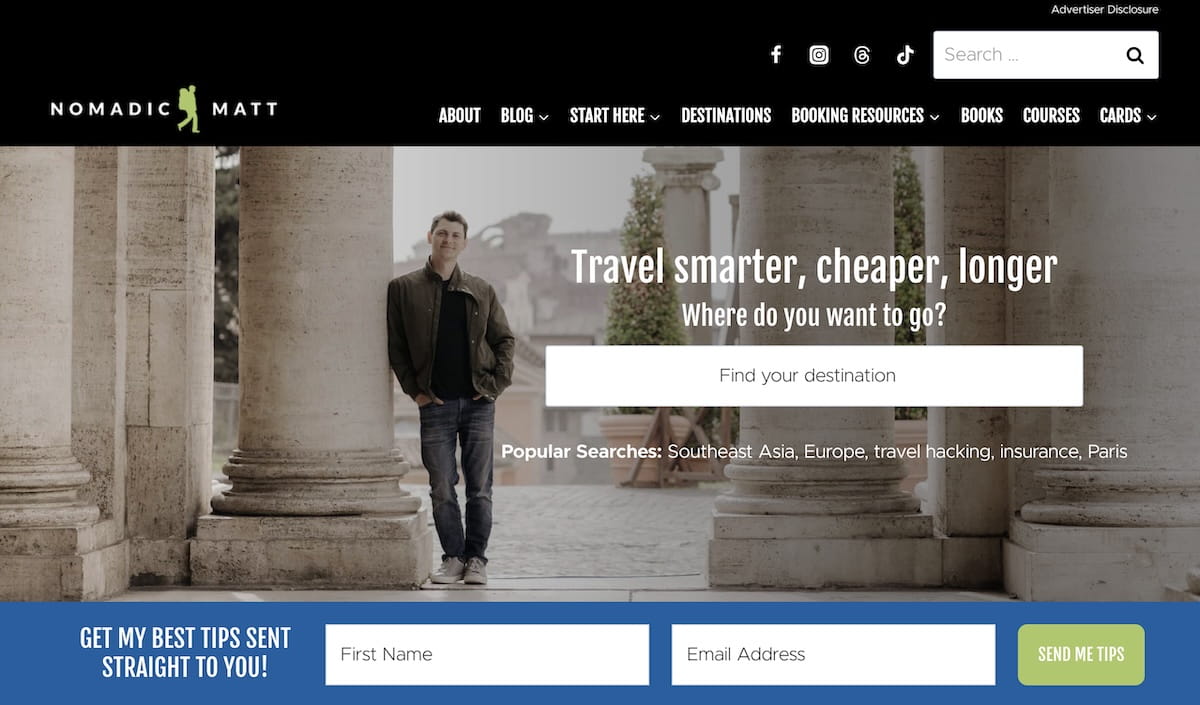
Luckily, Matt Kepnes, founder of the popular budget travel site Nomadic Matt, is here to help. Matt has survived nearly two decades of algorithm changes, with his advice landing him features in The New York Times, CNN, The Guardian, BBC, and Time, among others.
In this guide, he breaks down:
- His revised approach to SEO and AI SEO
- What pivoting away from Google looks like and where he’s seeing the best results
- How he’s building community in the age of AI
- How his monetization strategy has shifted as traffic sources have changed
- What he thinks the future of blogging looks like in the AI era
- And more!
By the end, you’ll have a clearer plan for building an audience you own and turning it into income, even as search traffic keeps shrinking.
💻 Bonus: This episode of The Profitable Travel Blogger Podcast includes options for learning through audio, video, or a text guide below!
💡Quick growth tips for travel bloggers:
-Search traffic is shrinking, so use social media to send people to your website, and your website to your newsletter.
-A newsletter is the one audience you own. No algorithm can hide it from your readers.
-Hosting webinars is a great way to build community. Offer a mix of free and paid ones to grow your email list and income.
🎁 Join Travelpayouts to monetize your travel recommendations. Their affiliate platform gives creators access to more than 90 travel brands in one place. New users can get a bonus of up to $100 when they sign up through my referral link — earned in stages as you hit commission milestones.
🎁 Grab my free Travel Blogger Resource Library featuring a Growing a Travel Blog in the Age of AI Cheat Sheet based on Matt’s tips! You’ll also get access to 75+ resources that can help you grow your traffic, email list, and income.
How To Grow & Monetize A Travel Blog In The Age Of AI [Audio + Video]
Future-Proof Your Travel Blog [Step-By-Step Guide]
The following is a summary of the podcast episode sharing tips for growing and monetizing a travel blog in the age of AI. It is transcribed as best as possible, with paraphrasing included. For the full strategy, make sure to listen to the audio or video version of the podcast above.
1) How did you get into travel blogging?
In 2006, I quit my job to travel the world after meeting backpackers in Thailand. I thought travel sounded way better than corporate life, so I took what I thought would be a gap year, just to get the travel thing out of my system before going back to corporate life.
But when I came home, I realized I didn’t want to go back. So I started my travel blog, Nomadic Matt, in 2008 as a way to freelance. The original version was about six pages: some tips, my bio, and my writing credits. It was basically a “hire me” page.
But I kept writing, and slowly but surely people started reading it. By 2010, I realized this was a full-time living, and I never looked back.
2) In the age of AI, do you still optimize for search at all, whether traditional SEO or “AI SEO” for tools like ChatGPT, Perplexity, and AI Overviews?
No, I don’t optimize for search anymore.
You can’t really optimize for AI tools. AI tools are mostly taking the top content that already exists and feeding it back to people.
I sometimes play with the bots and ask things like, “What are the best hostels in Paris?” Then I ask where they got those results. It’s all what was on the first page of Google.
If you’re not already in the big game, it’s going to be hard to break in.
Search optimization is basically dead right now. Google is trying to put its Gemini interface between people and websites, making it harder to get clicks. I think blogs are dead in the sense that you’re just going to get what you get for traffic. Optimizing for zero is still zero. If I’m number one in search but there are no clicks, what’s the point?
But you should still have a blog. You still have an audience. As you shift from Google to social media, you still need those followers to come to your website, and there needs to be information there when they do.
3) You mentioned pivoting away from Google. What does that look like in practice, and where are you seeing especially good results?
Instagram and TikTok are the main platforms I use. Between the two, I prefer Instagram, as it’s easier to drive people off the platform using ManyChat comment-to-DM automations.
The whole goal of your social media content should be to get people onto your website and onto your newsletter.
Here’s how it works for me:
- I post Instagram carousels.
- At the end, I add a ManyChat prompt telling people to comment a keyword to get the link.
- That link gets them to my website and onto my newsletter.
Tip: Skip the landing page. With a Kit automation, people can give you their email right in the DM and be signed up automatically. It removes friction, and the conversion rate is way better.
🎁 Bonus: Want to try this setup? Both the ManyChat and Kit links get you 30 days free of their Pro plans.
🎥 For help seeing success, this video shares what is working now on Instagram for growth:
4) Why are newsletters so important, and how do they actually make money?
A newsletter is the most important thing you can have, because you own it.
It can’t be missed. When I post a carousel, you may or may not see it, depending on the algorithm. But when you log back into your email, everything is there.
It lets you share direct links. When writing my newsletter, I can say, “I’m back in New York and I just did this tour. Here’s a link.” That’s an affiliate link, and that kind of direct linking can’t happen on social media.
Social media is great for growing your audience, but beyond brand deals, it’s not a great monetization tool. Once you have a newsletter, affiliate monetization becomes so much easier.

5) Bloggers are always told to focus on community so people seek you out directly. Do you agree, and how are you building community in the age of AI?
I think social media is a great place to build community. For this, I really like Instagram, as the algorithm is more geared toward showing people the accounts they follow.
YouTube is a great channel for building community too, and is probably the best platform for building an actual fanbase.
Your email list is where community deepens. Once people are on your list, you can start doing a lot more: in-person events, tours, meetups, and webinars. That fosters community much more, because people get to know you as a person, not just some account they follow.
6) If someone is just getting started with community through their newsletter, where should they begin?
I’d start with a free virtual event, like hosting a free webinar, since people sign up for free things far more often. You’ll get a lot of signups, but keep in mind that you’ll likely see around a 50% drop-off rate.
That’s fine: I do the webinar either way, then send a follow-up email with the replay and share relevant affiliate links. Those emails get around an 80% open rate and a super high click-through rate.
Then build up to paid webinars. A paywall might take you from 800 signups to 50, but 50 paid signups beat 800 free ones.
When should you start charging for webinars? From the get-go. Even with 30 people on your list, host a paid webinar to condition your audience to expect that you’re running a business. Maybe one person shows up, but treat them like the best person ever.
7) Income matters even more than traffic. How has your approach to monetizing shifted as your traffic sources have changed?
Since AI has shifted and basically killed Google, I focus a lot more on three things:
- Paid webinars. Hands down, I’m way more about these now.
- Newsletter sponsorships. I do far more of these than before.
- ManyChat into newsletters. This is how I turn Instagram followers into subscribers, and subscribers into affiliate income.
Before, we’d get a million visitors a month, and my ad revenue was in the five figures. When search was the main driver, the bang for my buck from optimizing for search was much greater than from Instagram. Instagram was just a fun way to expose people to my brand. Now that search is all about AI, Instagram is how I expose people to my brand and make money. It’s no longer just brand building. It’s monetization.
Collaborations: While Jessie loves newsletter swaps, I prefer Instagram collaborations. They’re good brand exposure and a lower lift. Someone likes your general content, subscribes, and then you can feed them whatever they want.
Affiliate marketing is really about reminding people. I’m always sharing my affiliate links. People want to help you as a creator, but they forget. Think about how you shop: you don’t stop to visit your favorite blogger’s website first, you go straight to Amazon.
So affiliate marketing isn’t only about optimizing a page for conversions. It’s about reminding people about your affiliate links over and over again.
Newsletter tip: I like to balance informational emails with sales emails that focus entirely on one specific product or affiliate, like a credit card review. That said, even the informational emails still mention the companies I use with affiliate links.
🎁 Don’t forget to grab your free Growing a Travel Blog in the Age of AI Cheat Sheet inside the Travel Blogger Resource Library! You’ll also get access to 75+ resources that can help you grow your traffic, email list, and income.
8) AI can replicate content so easily. How are you creating content that can’t be easily churned out by ChatGPT?
Anything you put on your blog is going to be found by ChatGPT and other AI tools.
What can’t be stolen is your newsletter. This is something you own. Anything you put on someone else’s platform comes with terms and conditions that let them train their AI on your content. Luckily, you can monetize your email list! Promote content links in your newsletter for traffic as well as products, affiliate links, and sponsorships for income.
Even your website isn’t safe. You could block bots or put your site behind a paywall, though I still don’t know how I feel about that. For the most part, you just have to assume that whatever you put online will be used by ChatGPT, Claude, or whatever comes next.
How this has changed my website: To fight ChatGPT, I basically don’t update my website much anymore. What’s the financial incentive to churn out lots of content when I’ll get no traffic from Google and ChatGPT will take it? That financial model is dead.
That said, there are exceptions. I have around 2,000 pages of content, and I keep about 30 or 40 of them updated. Those are the affiliate-heavy posts on the topics my audience cares about most, like finding cheap flights, travel insurance recommendations, and miles and points tips.

9) If someone is just starting out, how should they build a content plan in the age of AI?
It was never really about ranking in search. It’s always been about serving your readers.
Create content around your readers’ most frequently asked questions, whether it ranks number one or number 100,000. When readers come from social media, a podcast, or anywhere else, they should find answers.
For example, when someone DMs you asking how to find a cheap flight, reply with the post, which can include an affiliate link to the service you use.
Remember, too, that you can promote this content to your email list.
10) What’s a mistake you see travel bloggers making right now as they try to adapt?
Not building a community and not getting them off social media. I know so many people with hundreds of thousands of followers who have no other way to reach them, which is why they get so upset when the algorithm shifts.
Instagram’s job isn’t to make things easy for you. Its job is to make money for Meta. Your goals and the platform’s goals are opposite, and the same goes for Facebook, TikTok, and YouTube.
Build a community and get them off platform. That should be the number one thing you do.

11) What are your thoughts on creators having their own products?
It’s very important to have your own independent monetization system, because the algorithms are not your friend.
Personally, I have multiple products: webinars, trip planning, and ebooks. I do this because one thing won’t be right for everyone:
- Some people just want the ebook.
- Some will click your affiliate links.
- Some want to hire you for trip planning.
- Some just want to pick your brain, and an easy way to offer that is a webinar.
With multiple products, I can cater to the needs of more of my audience.
12) If you were starting from scratch today, knowing everything you know now, what would you focus on and do differently?
The newsletter is my answer to both. I didn’t start a newsletter until three or four years into blogging.
Back then it was RSS feeds, and you’d see the FeedBurner counter and think, “Wow, I have 50,000 subscribers!” But you didn’t have their emails.
I would replace that RSS feed with an email list on day one, even more so now that you’re not getting found through search.
Communities aren’t built on blogs anymore. That happens on social media now, but social media is an algorithm. So always focus on getting people off platform and into your own ecosystem, where you have their email or phone number and can’t be algorithmed away.

13) Do you have a number one strategy for growing your email list?
I host a lot of giveaways. Once a year I do a trip giveaway, using points to cover the cost.
Last year I gave away a trip to Japan, and I’m gearing up to give away a trip to Paris.
Instagram ads convert really well for this. I run cheap ads telling people to subscribe if they aren’t on the list. I also ask other creators to promote the giveaway in their newsletters, since it’s time sensitive and appeals to everybody.
ManyChat is huge for me too. With the Kit automation, the flow is simply “give me your email, great, you’re signed up.”
My list is around 200,000 people, but it shrinks over time and I no longer get hundreds of signups a day from search. A big trip giveaway adds 10,000 to 20,000 people in one go. Then it slowly attrits, and I do it again.
14) Looking ahead, what does the future of travel blogging look like as AI continues to advance?
I think we’re eventually going to lose the booking process. Your AI agent will do your bookings for you, and people will just tell it to sign up for a credit card directly.
Nobody will click on my links or yours, and the entire monetization strategy of the internet goes away, not only for bloggers but for companies like Expedia too.
So the future of blogging is creating your own community, so people find a way to support you, including subscription models. You need your own little fanbase where the links and support come from people who want to back you.
15) Thank you so much for sharing your blogging tips! Before we sign off, can you let everyone know where they can find you?
- NomadicMatt.com (website + email list)
- @NomadicMatt (Instagram)
Recommended Tools For Travel Blog Growth
Travelpayouts. A travel affiliate platform with 90+ brands across flights, hotels, activities, tours, eSIMs, and more. New users can get a bonus of up to $100 through my referral link.
Kit (get 30 days free of their Pro Plan). The email platform Matt uses, including an automation that signs people up straight from an Instagram DM.
ManyChat (get 30 days free of their Pro Plan). Turns Instagram comments into DMs with a link, sending followers to your newsletter.
➡️ Click here for a full list of recommended tools and resources for creators.
Bonus Blog Growth Strategies
Learn how to:
- Build wealth with irregular income
- Start a profitable local newsletter
- Monetize your creator skills through freelancing services
- Build systems in your blog’s backend
- Create high-engagement Instagram Reels
➡️ Click here for the full Profitable Travel Blogger Podcast episode list!
Get Notified About New Episodes
Don’t miss an episode! Subscribe to The Profitable Travel Blogger Podcast on your favorite podcast platform like Apple Podcasts, Spotify, and Amazon Music.
Prefer email? Click here to sign up for our Podcast Updates newsletter!
If you already grabbed the free Travel Blogger Resource Library, you’re already on the list to get notified. 🎉
Your Future-Proof Blogging Game Plan
To help you implement what you’ve learned, here is your 5-step action plan for growing and monetizing a travel blog as search traffic shrinks:
1) Stop chasing rankings, but keep your blog. Your website is where social followers land to get answers. Focus on your readers’ most frequently asked questions, and keep your affiliate-heavy posts up to date.
2) Use social media to pull people off platform. Post Instagram carousels that end with a ManyChat prompt, and send people to your website and newsletter instead of hoping the algorithm shows your content.
3) Make your newsletter the priority from day one. It’s the one audience you own. Remove friction by using a Kit automation that signs people up inside the DM, and remind people about it constantly.
4) Monetize your list in more than one way. Share affiliate links often (mixing information with the occasional pitch), host free webinars that build up to paid ones, and offer products so people have different ways to support you.
5) Grow your list and community on purpose. Run a giveaway, collaborate with other creators on Instagram, and host events like webinars or meetups so people get to know you as a person, not just an account.
🎉 Don’t forget: You can grab my free Growing a Travel Blog in the Age of AI Cheat Sheet inside the Travel Blogger Resource Library, which also includes 75+ resources for growing a profitable blogging business.
➡️ Click here to access the free Travel Blogger Resource Library!
How are you future-proofing your blog in the age of AI?