Creating Financial Stability With Irregular Income: Tips From A CFO
This post contains affiliate links, including Amazon affiliate links. If you purchase through these links, I may earn a commission at no extra cost to you. As an Amazon Associate, I earn from qualifying purchases. Thank you for your support!
*Disclaimer: This post shares general information for educational purposes only and is not personalized financial, tax, or legal advice. Please speak with your tax advisor and financial planner about your specific situation.
Does your income look completely different from one month to the next?
Irregular income is one of the most stressful parts of creator life. A great month can be followed by a slow one, making it hard to feel financially secure, let alone build wealth.
Luckily, fractional CFO and tax strategist Katherine Pomerantz is here to help. An actress turned accountant, Katherine has spent 10 years as a CFO for expert-led and personal-brand businesses making $1M–$20M a year.
In this guide, Katherine breaks down:
- How to find your “enough number” when your income fluctuates
- How much cash to keep as a buffer (and why the rest should be invested)
- What to do with your money as soon as it lands in your account
- How self-employed creators can save more for retirement while lowering their taxes
- And more!
By the end, you’ll have a simple money system for feeling financially stable, no matter what your income looks like month to month.
💻 Bonus: This episode of The Profitable Travel Blogger Podcast includes options for learning through audio, video, or a text guide below!
💡Quick money tips for creators:
-Set aside money for taxes first, in a separate savings account. Then give 5–20% of what’s left a job, like investing or building your cash buffer.
-With variable income, 1–2 years of cash is a comfortable buffer. More than 3 years is likely too much.
-Your blog isn’t passive income. True passive income comes from owning assets you don’t operate, like index funds.
🎁 Join Travelpayouts to monetize your travel recommendations. Their affiliate platform gives creators access to more than 90 travel brands in one place. New users can get a bonus of up to $100 when they sign up through my referral link — earned in stages as you hit commission milestones.
🎁 Grab my free Travel Blogger Resource Library featuring a Financial Stability for Travel Bloggers Cheat Sheet based on Katherine’s tips! You’ll also get access to 75+ resources that can help you grow your traffic, email list, and income.
How To Feel Financially Stable With Irregular Income [Audio + Video]
Money Tips For Creators With Irregular Income [Step-By-Step Guide]
The following is a summary of the podcast episode sharing tips for feeling financially stable with irregular income. It is transcribed as best as possible, with paraphrasing included. For the full strategy, make sure to listen to the audio or video version of the podcast above.
1) How did you get into tax strategy and financial coaching?
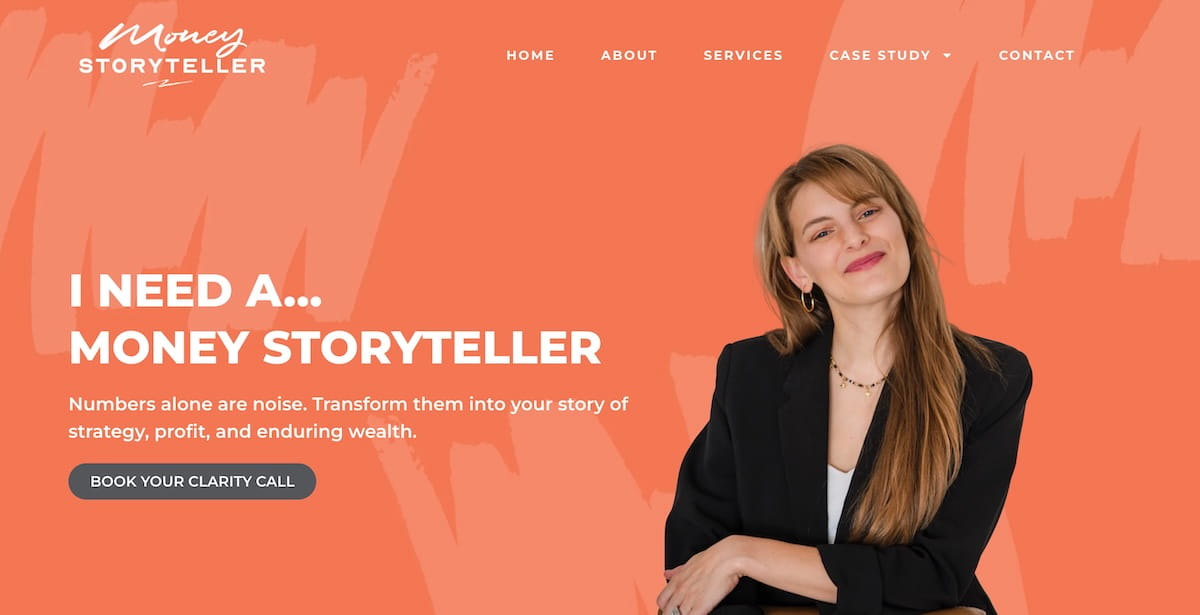
I run a fractional CFO and tax advisory team through my business, Money Storyteller, which utilizes the Money Storyteller Method.
Money stories drive everything. Every decision we make is a financial decision, and our past experiences with money can hijack our stress response and influence those decisions. That’s why so many people feel like they’re “just not good with money.”
Knowing the systems, jargon, and rules is only part of it. You also need to understand yourself. I actually came to this as a storyteller first. I’m an actress turned accountant, with a background in choreography and dance.
Like a lot of actors, I was working lots of jobs and still barely paying my bills. At my low point, I remember thinking: If I could figure out how money worked, I could help a lot of people.
About a year to the day later, I’d started my own accounting firm. It turns out money is an abstract language, just like art. We use it to make sense of chaos and to assign value and meaning to things.
My storytelling background helped me get good with money really fast, and that’s what I teach my clients to do too.
2) Today is about feeling financially stable and building wealth. Why does that conversation start with taxes for you?
If you want to build wealth, you eventually need to learn about asset classes and investing.
You need to give your money jobs, so it can work toward what you want without you having to work all the time.
That’s what financial freedom is: your money outpacing your own work. But most people don’t have time to read stacks of investing books.
What people do know they need to do is file their taxes. And the tax code is set up so that every deduction is like a little treat for good financial behavior, like:
- Saving for your own retirement
- Paying for your own healthcare
- Investing in your business
The better you get at investing and letting your money earn more of itself, the less you’ll pay in taxes.
Everybody can get on board with that story, which makes taxes the perfect gateway into the rest of the wealth conversation.
3) One concept you talk about is finding your “enough number.” Can you explain what that is and how it helps someone with unpredictable income feel more financially secure?
Traditionally, your enough number is simply the point where you have enough to do what you want.
But with unpredictable income, and future expenses to think about 10, 20, or 30 years from now, that can quickly feel overwhelming.
Here’s a more helpful way to think about it:
Start with your day-to-day enough number. This is what you need to live your current lifestyle, including the basics of keeping yourself clothed, fed, and healthy (good food, exercise, and doctor visits).
Control your living expenses. This is your first lever. Can you live or travel more frugally? Personally, I’ve always been fine with a tiny apartment, since I’m not spending much time in it.
Look at where your cash comes from. There are a few paths here:
- The traditional path: Work a salaried job for 40 years, spend less than you make, invest the rest, and retire. It’s wildly effective, but not everyone wants to stay in the same job or location that long.
- The FIRE movement (financial independence, retire early): Live as frugally as possible and work as hard as you can so you can retire early. This works too, but it involves a lot of hustle up front.
- Periods of working and not working: For example, working nine months a year and taking the summer off to go to Italy. This one tends to fit the travel blogger lifestyle best.
That’s why I want to know your enough number from two sources: the cash flow from the work you’re doing now, and the money you’ve invested.
If you haven’t started investing yet, don’t panic. Two rules of thumb show how powerful it can be:
The 4% rule. If your money is invested in a basic stock portfolio, you can take out about 4% per year while still maintaining your original savings. So if you save $100,000 by age 25, you can take out $4,000 a year, which is enough for a pretty nice trip annually.
The Rule of 72. Divide 72 by your annual return to see how many years it takes your money to double. The S&P 500 has earned about 8% on average over the last 100 years, and 72 ÷ 8 = 9. So your money doubles about every nine years.
That means $100,000 invested at 25 becomes:
- $200,000 in 9 years…
- $400,000 in 18 years…
- $800,000 in 27 years…
- $1.6 million in 36 years…
…without contributing another penny!
The earlier you start, the more time compound interest has to work for you.
Tip: You don’t need to read a single book to get started. You can open a brokerage account, invest in the S&P 500, and let it ride. You might even do better than the average investor, since people who watch their investments closely tend to make emotional decisions and pull their money out when they get scared.

4) Why shouldn’t people keep all of their savings in cash?
You can be a really good saver, but if you leave it all in cash, it just sits there. The money isn’t being given a job.
When you buy a stock, you’re buying a portion of a company. When that company makes a profit, you benefit based on your percentage of ownership. It works the same way as your travel blog, where you’re entitled to 100% of the profits.
The smarter the team leading the business, and the more profit they drive, the more you benefit.
And anybody can do this. You used to have to buy a whole share, but now you can buy fractions of shares, so you can get started with just a couple hundred dollars.
5) There are so many investing platforms out there. Where should people actually get started?
First, a quick note: I’m not a wealth advisor. My focus is driving profits and cash flow so that money can get invested. You’ll want to consult an expert who understands the lifestyle you want to build.
With that in mind, here’s what I recommend for travel bloggers:
Keep a larger-than-average cash pool. Your income is variable, so extra cash protects your investments. That way, they can stay in high-growth investments and do their job.
Try a robo-advisor. Platforms like Wealthfront and M1 Finance are super easy to start with. You only need a couple hundred dollars, and the platform makes the investing decisions for you.
Be careful with gamified trading apps. Apps like Robinhood make it easy to buy individual stocks and watch them go up and down each day. You can earn good money that way, but it’s basically a day job. And I want to go travel!
Consider diversifying. For example, you might add real estate to your portfolio through a Real Estate Investment Trust (REIT).
Or work with a fee-only financial advisor. You can pay a one-time consulting fee to create your game plan, then follow it. Two resources:
- Finchly offers wealth advising for content creators, with a service that starts at $0 invested.
- XY Planning Network lists fee-only financial advisors.
- Note: Advisors are licensed by state in the US, so you’ll need one in your home state (wherever you’re a permanent resident). This is one of the few disadvantages of being a full-time digital nomad or traveler.
What “fee-only” means:
- Fiduciary: A fiduciary advisor is required to act in your best interest. This is different from an advisor who earns commission, where the more products they sell, the more money they make, even if the product isn’t the perfect fit for you.
- No assets-under-management fees: Some advisors take a percentage of the money they manage every year, whether your investments win or lose. Taking 1–2% a year doesn’t sound like a lot, but over decades, those fees can cut your compound growth by as much as half.
And let’s normalize this: if you’re truly living a nomadic, entrepreneurial lifestyle, you won’t always be making money. That’s okay!
As long as you have a game plan to make money now, and you know your enough number for later, you’re fine. It’s a totally reasonable and successful way to live. It just looks different from the traditional path.
🎁 Don’t forget to grab your free Financial Stability for Travel Bloggers Cheat Sheet inside the Travel Blogger Resource Library! You’ll also get access to 75+ resources that can help you grow your traffic, email list, and income.
6) People with inconsistent income might want to keep more in cash. How can they figure out how much to keep in cash versus investments?
My answer is a bit unconventional. Whether you make lots of money or a little, what matters is how you feel when you honestly ask yourself:
“If I lost my income, how long would it take me to replace it?”
That depends on your enough number. Someone who needs $20,000 a month for kids, a big house, and cars has a different number than someone traveling full time who only needs a few thousand dollars.
It’s a very personal number:
- Me: I’m a super saver, so I want at least nine months, even though realistically I could replace my income in about five.
- Others: Some people say they could figure out their next income source in a month by running a sale, hosting events, or getting a job. I’d still suggest a bit more cash if you’re leaving a salary to travel.
One to two years of cash is very comfortable. I’d say no more than three years.
Even if you lose all your income and have to pull from your investments during a market downturn, it will probably only take one to two years for the market to recover.
Remember, your cash is a buffer. You want income from your blog and side hustles, plus your investments. The buffer covers you if one of those takes a downturn, so you can wait it out without letting go of your compound interest.

7) Let’s talk about passive income, something all bloggers want to increase. How can creators build true passive income without extra work?
Imagine me looking you in the eyes right now: a blog is not passive income. An online course is not passive income. Even a wildly successful YouTube channel with brand sponsors and ad revenue is not passive income.
It’s non-traditional income. That doesn’t make it passive.
A business only becomes passive income once you’re no longer the operator. From there, there are two paths:
1) Build the business so it runs without you. Grow your revenue enough to hire a team, so you don’t have to be the face or make all the content. Maybe you’ll even sell it someday.
2) Earn more than your enough number, and invest the difference. Get as much cash out of your business as possible and invest it elsewhere, like:
- Real estate you don’t manage yourself
- Index funds
- Bonds, commodities, or other assets that pay interest or grow in value
That’s why the wealthiest people make so much money: most of their wealth is invested in the stock market. They’ve given their money to business owners who put it to work and pay them back.
Whichever path you choose, it will take some amount of work. The question is what trade-off you’re willing to make for that work.
The same goes for investing. Stocks, bonds, real estate, commodities, and crypto all have their own rules, risks, and trade-offs. Knowing how you like to work will help you choose the type of investing that feels good to you.
8) Once money actually lands in their account, what should bloggers be doing with it to build long-term wealth?
Cash discipline is 100% the way to build wealth. You need a plan for when that cash hits your account.
Step 1) Set aside money for taxes. Know what your tax liability will be, and keep that money in a separate savings account so it doesn’t accidentally get spent. Taxes will come due, and it’s one of the only debts you can’t get rid of through bankruptcy. You don’t want to be unable to return to your home country because of unpaid taxes!
Step 2) Know your targets. Are you paying down debt? Growing your nest egg? Building your cash buffer, both personally and in your business? You can set target rates, or keep it simple. For example, if you’re paying down debt, you might put 50% toward debt and 50% toward savings.
Step 3) Give 5–20% of your after-tax income a job. I think 20% is a great target for the lifestyle travel bloggers want. If your income is variable, you need to learn to live below your means now.
That money’s job might be:
- Paying down high-interest debt
- Getting saved and invested for the future
- Building your cash buffer to protect your savings and investments
If that’s all you do, you will win over time. Becoming wealthy is easy. We just don’t do it because it’s boring.
How often to do this: I recommend monthly, or at least quarterly. This is the idea behind the book Profit First by Mike Michalowicz. Take out your profit first, then save for taxes, and then handle your expenses. You can do the same thing for your household.
Tip: Even with variable income, I like setting up automatic transfers. If I know roughly how much I want saved and invested, I’ll pre-schedule the next couple of months so it happens without relying on my attention.
Try two separate money check-ins:
- Cash planning (beginning of the month): Did all your clients and product payments come through? Follow up with anyone who hasn’t paid you (brands are often late!), then do your cash split.
- Strategy: Look at the story behind your numbers. What can you restructure? Do you like the direction things are headed?
If you only have time for one, do the cash planning. It keeps the lights on.

9) Where do retirement accounts, like a Solo 401(k), come into this?
Taxes are the biggest expense you’ll pay, personally and professionally. Most of the way I reduce taxable income for clients is by moving the money they earn into a retirement vehicle.
So in your cash plan, retirement contributions come first, as part of your profit split.
If you run payroll for yourself (for example, as an S-Corp), contributions should run through payroll, since they need to be reported on your W-2.
If you don’t run payroll, a SEP IRA or Solo 401(k) are two of the easiest options to start with.
Here’s why a Solo 401(k) is so powerful for self-employed creators:
- As the employee, you can contribute up to $24,500 (at least this year; double-check as this number can change year to year).
- As the employer, you can make an additional profit-sharing contribution on top of that.
- If the account is set up right, you can also make Mega Backdoor Roth contributions.
Altogether, that can reach roughly $70,000–$80,000 a year, depending on your age. Compare that to a regular W-2 employee, who can only invest about $25,000 a year in a tax-advantaged retirement account.
A Solo 401(k) also works well for smaller incomes. If your blog makes $20,000, you may be able to shelter nearly all of it.
SEP IRAs are even simpler, but you need more income to reach the same savings levels. And once you’re earning a lot, you can add a cash balance plan on top and save even more.
Most people ask me for secret tax strategies, but they haven’t actually maxed out their retirement accounts. Start there.
Tip: Talk to a tax expert about Roth versus traditional accounts, since the right choice depends on your age and income. But if you just get started, even imperfectly, you’re so far ahead.
10) What’s the number one thing you wish people understood about money?
Cash flow. Money can’t sit still.
We live in what’s called a fiat currency system, which means money has value because we all agreed it does. The US used to be on a gold standard, where you could exchange a dollar at the bank for its value in physical gold.
During the Great Depression, people rushed to pull their money out of banks, and the banks failed. To stop those runs, the government stopped backing money with gold and started insuring bank deposits instead (that’s FDIC insurance, up to $250,000). This became official law in the 1970s.
So money is essentially made up. It’s a current, a flow of energy. That’s why it can never truly sit still:
- In a savings account, the bank is lending that money out and earning interest on it.
- Stuffed in a mattress, it’s losing value to inflation.
Once you understand that money is always moving, investing feels a lot less scary. You’re just giving your money a job so it can make more of itself and come back to you.
This mindset also changes how you run your business. When you read your financial statements, you can look at each expense and ask:
- What job was this supposed to do?
- Did it deliver?
- Did I get the return I expected from this brand deal or affiliate campaign?

11) You’ve talked a lot about behavior today. Why is this the secret to succeeding financially or not?
We’re systemic creatures. We live in systems, we build systems, and our bodies run on a biological system.
Here’s how a basic stress response works: something alarms you, your body floods with cortisol, and blood flow drops to the parts of your brain responsible for creativity and problem-solving.
Those are exactly the parts you need when making business decisions, planning trips, or creating blog content.
Most people are living with a low-dose stress response to their finances without even realizing it. Thoughts like:
- “I don’t know where my next paycheck is coming from.”
- “I can’t let off the gas.”
- “None of this is working. Why should I even bother?”
The more you’re in that story, the more that stress response shuts down your best self and your best content. That’s why the Money Storyteller Method covers three pieces:
- Your money story, which drives your behaviors
- Your money system, which includes your bookkeeping and also your nervous system and how you show up as a CEO
- Your money map, which is your profit plan, business structure, and tax strategy
Remember that monthly money meeting? That’s a behavior. If you show up for it consistently, you’re going to win.
And it’s okay to live differently from everybody else. If you know your enough number and your cash flow sources are handled, who cares if you never had a W-2 or never made six figures?
You might be way more successful than someone who did, simply because you had good behaviors the whole time.
12) Through your work, you get to see the financial strategies of multi-million-dollar companies. What are the biggest things these companies do differently that smaller creator businesses and personal brands could replicate?
These days, I can usually sense whether someone will be a six-figure or seven-figure brand when I meet them. It comes down to how they treat their money and their financial team.
Those who get stuck tend to be a bit controlling. They need to know every little detail and understand the full picture before they’re willing to play the game. That usually shows up in other areas of their business too. It’s harder for them to delegate and level up, because things start to feel out of their control.
Those who grow to seven or eight figures ask smart questions and want to be involved. But they also say, “I trust your work. I don’t need all the details.”
If you want to grow beyond a solo operator, you need to build the skills of trust and delegation. For example:
- Hire your first VA instead of assuming software will fix everything.
- Give people jobs, and let them work. Yes, they could fail. But you’re also giving them room to succeed, and that success comes back to you (just like investing!).
- Teach what you’re good at. Say you’ve nailed your brand deal process. Instead of doing it all yourself, you could hire a relationship manager whose only job is nurturing those partners. Brands might like them just as much, and you can grow twice as much.
One more thing I see with a lot of content brands: frugality is extremely important and a winning life skill.
But know when you’re being frugal and when you’re just being cheap. Be willing to stretch yourself to reach that next level. That’s what separates the people who stick with it from the people who don’t.

13) Thank you so much for sharing your financial tips! Before we sign off, can you let everyone know where they can find you?
Recommended Tools For Managing Irregular Income
Wealthfront. Jessie’s preferred platform for her high-yield Cash Account (similar to a savings account), Roth IRA, and personal investing — including a robo-investing option where their tool does the work for you. New Wealthfront clients who use my sign-up link will get a bonus offer, as will I for making the referral.
XY Planning Network. A directory of fee-only, fiduciary financial advisors, many of whom offer one-time planning sessions.
Finchly. Wealth advising for content creators, with a service that starts at $0 invested.
Profit First by Mike Michalowicz. A book on the “pay yourself first” cash system Katherine recommends.
➡️ Click here for a full list of recommended tools and resources for creators.
Bonus Creator Income Strategies
Learn how to:
- Create content that sells & converts on social media
- Start a profitable local newsletter
- Monetize your creator skills through freelancing services
- Grow a Patreon for recurring revenue
- Do a content audit for more traffic & income
➡️ Click here for the full Profitable Travel Blogger Podcast episode list!
Get Notified About New Episodes
Don’t miss an episode! Subscribe to The Profitable Travel Blogger Podcast on your favorite podcast platform like Apple Podcasts, Spotify, and Amazon Music.
Prefer email? Click here to sign up for our Podcast Updates newsletter!
If you already grabbed the free Travel Blogger Resource Library, you’re already on the list to get notified. 🎉
Your Financial Stability Game Plan
To help you implement what you’ve learned, here is your 5-step action plan for feeling financially stable with irregular income:
1) Find your enough number. Know what it costs to live your current lifestyle, and map out where your cash will come from: your blog, side gigs, and eventually your investments.
2) Build your cash buffer. Ask yourself how long it would take to replace your income if it disappeared. For most creators, 1–2 years of cash is a comfortable cushion.
3) Do a monthly money split. Set aside taxes first, in a separate account. Then give 5–20% of what’s left a job: paying down high-interest debt, investing, or building your buffer.
4) Prioritize retirement accounts. If you’re self-employed, look into a Solo 401(k) or SEP IRA to lower your taxes while you build wealth.
5) Invest simply, and let it ride. Start with a couple hundred dollars (or more) in a robo-advisor or broad index fund, and avoid pulling your money out when the market gets scary.
🎉 Don’t forget: You can grab my free Financial Stability for Travel Bloggers Cheat Sheet inside the Travel Blogger Resource Library, which also includes 75+ resources for growing a profitable blogging business.
➡️ Click here to access the free Travel Blogger Resource Library!
What money habits have helped you feel more financially stable with irregular income?